Despite the wealth of data about disasters in Metro Manila, no dedicated study has holistically examined the risks associated with the Malabon-Navotas-Tullahan-Tinajeros river system (MANATUTI), especially in an urban landscape perspective. A pilot risk assessment of the river system was conducted using the integrated risk management, landscape, and urban resilience 190 approaches. Document analyses, key informant interviews, focus group discussions, and field visits were done to identify and analyze the hazards that pose threats to the communities along MANATUTI, especially the urban poor, and how vulnerabilities aggravate and capacities mitigate these risks, especially in the socio-economic, environmental, infrastructural, institutional, and governance aspects of the river system. Communities in the river system face severe risk to compound hazards such as flooding exacerbated by ground subsidence, sea-level rise, and storm surge, fire and liquefaction resulting from earthquake, and public health outbreaks made favorable by increasing temperature, environmental pollution, and congestion, among others. These are worsened by extreme poverty and the powerlessness of the greater population and the highly fragmented urban planning and risk management efforts in the landscape. Nevertheless, the inclination of the communities toward collaboration and transformation, alongside expansive rooms for improved governance, are important capacities that may enhance their resilience to disaster. A formal, well-supported, landscape-wide, inter-community governing institution that practices equitable distribution of responsibilities and resources is deemed essential to realize a comprehensive and effective disaster risk reduction and management in the river system in the face of rapidly changing climate and environment.
To view and download the full document, please click here.
The climate outlook for February-April 2021 was based on PAGASA Climate Forum. This contains the compiled relevant climate information for INCREASE areas and are sent to each specific municipality. This can be used as a guide to planning out activities including food production so climate-related risks are reduced. This is updated every quarter.
Below you may find a gallery of photos detailing the climate outlook for the said period. There are also area-specific versions of the material. You may click on each photo to enlarge it or access the download link.
The 2020 Alternative Temporary Shelter (ATS) Manual is an initiative of the Moving Urban Poor Communities in the Philippines toward Resilience (MOVE UP) Project. This manual is intended for new and experienced users with zero to advanced ATS System and shelter response knowledge. This manual aims to describe the importance and practical applications of ATS and offer step-by-step guidance on properly adopting and implementing select ATS solutions as a form of shelter response and early action during emergencies. This manual provides guidance to local government units, civil society organizations, community members, and other stakeholders on addressing the immediate shelter needs of internally displaced populations (IDPs) within a 24- hour to 36-hour period after a disaster and even for long-term displacements while conforming with universally accepted humanitarian principles and standards. This manual is a working document and shall be updated from time to time.
Target Users
This manual is principally intended for local government units (LGUs) and communities to augment their shelter response and early action capacities during emergencies. The manual also targets the private sector, civil society organizations (CSOs), humanitarian organizations, and other actors working closely with communities to build their resilience.
This report is based on CARE and ACCORD’s partnership with communities, PAGASA, and PHIVOLCS in previous projects implemented using Integrated Risk Management, and which received support funding from the European Civil Protection & Humanitarian Aid Operations (ECHO) and the Partners for Resilience project.
Natural hazards, climate change, and unrestrained ecosystem degradation are spawning extreme events, resulting in massive losses of lives and livelihoods.
Early warning systems (EWS) are crucial in reducing the risks to which vulnerable communities are exposed: effective ones can save countless lives and livelihoods, and less effective ones can turn hazards into disasters and extreme events.
It can provide the opportunity for individuals, communities, governments, businesses, and others to take timely action to reduce risks in advance of hazardous events. This, in turn, contributes to building community resilience. But for an EWS to be effective, it needs to be end-to-end, people-centered or community-based, and landscape-wide.
Community-based refers to an EWS that gives premium to community participation and ownership of the system. A landscape approach means it encompasses larger landscapes such as river basins or watersheds. This requires the harmonization of systems within a landscape, and cooperation among political and administrative units sharing the same landscape.
In the municipality of Saint Bernard in the province of Southern Leyte, the setting up of the EWS, among other DRR and climate change adaptation actions, was occasioned by a landslide that wiped out an entire barangay (village) in 2006. The event underscored the municipality’s vulnerability to multiple hazards and the urgent need to improve preparedness.
Through the collaboration of the municipal LGU, government agencies, civil society organizations, and community members, the EWS was instituted. In 2013, their community-based local flood EWS was recognized by the UN Sasakawa Award for Disaster Reduction for its innovative approach that combines technology and comprehensive social preparation. It was one of six projects from around the world that received the award.
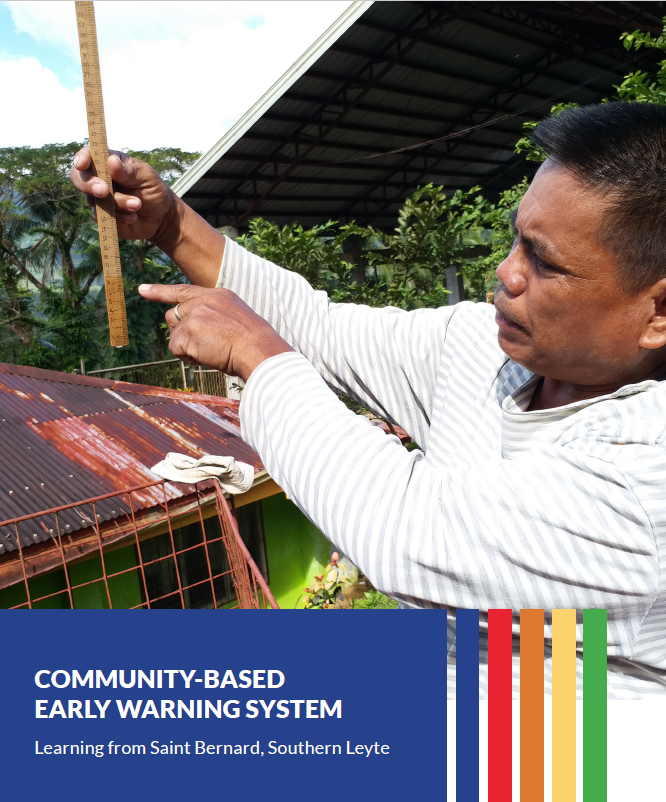
This study presents Saint Bernard’s experiences and lessons learned in setting up and managing the end-to-end, community-based, and landscape-wide EWS for floods, landslides, and tsunamis.
When lockdown measures were implemented to prevent the spread of COVID-19, even development projects were halted. Community-based trainings and workshops implemented by actors from outside the barangays were not allowed as they could be carriers of the virus. Local leaders play a critical role in a time when external support is limited and when the community’s safety is prioritized.
CARE local partner organization, ACCORD, Inc., ensures that potential leaders are recognized and gradually help them develop their capacities, self-confidence, and credibility. ACCORD shared, “Organizing and building capacities of local champions, community facilitators, and project steering committees at the barangay level was done as part of the project’s adaptive and sustainability measures. When staff’s mobility was restricted, valuable assistance was provided by the community champions – not only in the implementation of emergency responses on the ground but also in setting up regular project activities with our field teams. The project intends to engage and work with the same champions throughout the project, whose capacities for local leadership will remain, even after project closure.”
Among these local leaders is Josefina, 65, who serves as a Barangay Health Worker in Cullit, Gattaran in the province of Cagayan. Her daily duties include monitoring the health of children and elderly persons in their community. Since resources are scarce, she also helps out in medicine allocation, prioritizing the old and the sick. Now that there is a pandemic, she also helped out in the Social Amelioration Program (SAP) of the government, ensuring that the most vulnerable are included in the list. Josefina said that what she does in her barangay brings her happiness because she was able to provide help to her fellow senior citizens, especially now that the pandemic made serving her community more challenging. She recalled that her worst experience of a calamity was in 2012. She shared, “Our community and livestock had to be evacuated in higher grounds, and whatever was left behind were covered in thick mud after being submerged in the flood. Our family and neighbors had to clean the waist-deep mud in our houses, and had to sleep on the streets for about three weeks.” Because of this, she recognizes the importance of disaster preparedness, “the INCREASE project helped our community in planning and preparing for hazards and disasters.”
Josefina serves as their Barangay Health Worker and an active champion of INCREASE Project
To also continue actively involving the communities despite the restrictions, INCREASE also responded to COVID-19. The timing of the pandemic coincided with lean season when farmers had to engage in alternative income-generating activities such as buying and selling vegetables. With lockdowns and restrictions in accessing goods, such activities are not allowed. For Josefina, “the rice packs helped my community, especially those whose livelihoods were affected because of the travel restrictions and
lockdown. Meanwhile, the COVID-19 information materials remind my community to follow health protocols and what to do to protect themselves from the virus.”
Involvement of local actors also includes inviting them in knowledge exchange sessions that are relevant in their current context. Made possible through the Resilience and Innovation Learning Hub (RILHUB), INCREASE partner LGU in Cagayan was able to attend relevant webinars on resilience and DRR – covering topics such as Contingency Planning during COVID-19, Setting Up Community Quarantine Facilities, and Camp Coordination and Camp Management Training. Such information exchange sessions were seen timely by local actors as these webinars coincided with their preparation timelines for updating municipal disaster risk reduction plans, comprehensive development plans, comprehensive land use plans, and local climate change action plans – undertakings defined as actual project outputs in INCREASE’s result framework, and areas in disaster governance INCREASE’s technical assistance seeks to enhance.
While activity implementation under INCREASE remains restricted, it is through these emergency responses and knowledge exchange sessions that ACCORD was able to check-in, and assess the evolving needs of INCREASE barangays in actual emergencies. Local leaders were also more involved in the project and appreciate its flexibility in delivering the appropriate emergency response given the urgent situation.
by CorDisRDS, Inc.
The Cordillera Disaster Response & Development Services Inc (CorDisRDS Inc.) is a non-government organization providing disaster response and community development services to the communities of Cordillera Provinces: Apayao, Kalinga, Abra, Mountain Province, Ifugao, Benguet, and Baguio City. Their main activities include facilitating assistance to disaster-affected communities and helping in the distribution of relief assistance, giving training and seminars to capacitate community and people’s organization leaders and their members.
Support given by CARE:
CorDis-RDS is the local partner of CARE Philippines in implementing INCREASE project in Mountain Province. INCREASE or Increasing the Resilience to Natural Hazards aims to increase the resilience of
45,000 women and men small-scale farmers and fishers, including 720 extreme poor female-headed households, to natural hazards and the effects of climate change.
During the COVID-19 pandemic, CARE Philippines and CorDis-RDS, has provided personal protective equipment to municipal local government units (MLGUs) and sacks of rice as a relief to communities in Barlig and Natonin, Mountain Province.
COVID-19 information materials were also distributed in the areas to promote preventive measures against the coronavirus
The Problem
What has been your experience since the COVID-19 pandemic started?
The CorDis-RDS team has experienced challenges in reaching the communities because of travel restrictions. Before community quarantine was implemented, the team would spend 2 weeks in INCREASE areas where they would visit 4 barangays in two municipalities. But because of the pandemic, they had to cut their field work short to one and a half week covering three barangays. Since then, they were not able to go back to these communities.
According to Liza Lomong-ey, CorDis-RDS Field Officer, “Since the declaration of enhanced community quarantine in March 2020, it has been so stressful because the team was not able to personally reach partner communities and local government units (LGUs) in this trying time and we have not implemented activities for almost 6 months and are confined within our homes and office due to the safety protocols being implemented.”
How have you adapted operations to reach your beneficiaries?
The pandemic has heightened the importance of network-building, especially on the ground, in implementing emergency response and development projects. While faced with travel restrictions, the team has worked on strengthening their relationship with people’s organizations and LGUs so they can understand the evolving needs of the communities.
Liza mentioned, “Communication between INCREASE team and partner LGUs was sustained through constant updating and coordination via phone calls and text messages. From constant updating with MLGUs and partner BLGUs, COVID responses in Natonin and Barlig namely the provision of PPES and rice assistance were implemented. This was made possible through building partnerships with LGUs and their willingness to implement such.”
It is also important to keep the response strategy adaptive to the changing situations in the communities. For example, Barlig and Natonin are in the same province but follow different process in implementing relief distribution.
Liza shared, “The distribution of PPEs and sacks of rice were implemented by the municipal disaster risk reduction officer. Particular for the PPEs in Barlig and Natonin, it was channeled to the PDRRM office which was later fetched personally by Barlig MDRRM officer together with the PPEs for Natonin. Likewise, the rice distribution in the municipality was implemented under the supervision of Barlig Mayor’s office and MDRRM officer. In Natonin, the distribution was implemented directly by partner BLGUs.”
COVID-19 response was delivered with the help of BLGUs in INCREASE project areas
Since face-to-face interaction was not possible for CorDis-RDS team, they have supplemented the efforts of the LGUs with localized communication materials. This way, the communities would have reference materials for long term preventive measures as a community against COVID-19.
“We were also able to reach our partners through sending a localized IEC material on reminders for COVID 19 to 6 communities in Natonin and a minimal copy of COVID flyers (long term measures) to selected LGUs in the municipality,” said Liza.
What has been the ‘word on the ground’?
Community lockdowns were implemented by the government, limiting people’s movement and livelihood options. This has negatively affected their income as several businesses have closed either temporarily or permanently. A lot of people have lost their jobs, while farmers couldn’t reach market places to sell their produce because of the travel ban.
Liza said, “INCREASE areas in Mountain Province are affected by this COVID pandemic in terms of economic aspect. Their livelihood is affected due to protocols on public transportation and transport of goods.”
How do you think the typhoon season is going to affect operations?
Operating in disaster-prone areas, CorDis-RDS team is used to shifting to emergency response whenever it is needed. However, this means that the regular activities being implemented for INCREASE project will have to be re-strategized so it can be pushed through in an efficient manner.
Liza shared her worries about the typhoon season, “The implementation of planned activities in two partner municipalities will surely be affected this last quarter of the year if there will be typhoons that will hit Northern Luzon. Some planned activities will not be implemented, the main reason is accessibility/ road cuts given the location of Natonin and Barlig which is mountainous in nature which is also prone to landslides and erosion. In addition, Cordis will surely shift to emergency mode wherein all pending activities and office works will be set aside for the meantime.”
Do you think you can weather the storm?
“The team together with partner communities must weather the storm, not literally, but to adjust on whatever the plan and activities are and to strictly follow LGU protocols in this pandemic period,” said Liza.
CorDis-RDS team understands that increasing resilience to natural hazards is much more needed in a pandemic. Preventive actions to protect self and others should be observed while planning for or experiencing disasters. Being fully informed of these measures and strengthening the capacities of the local actors are their best way to weather the storm
by: Leyte Center for Development, Inc. (LCDE)
Responding to the unique needs of women and girls
Food, water, and medicine are limited during and after a crisis. In a household where resources are limited, women are usually the ones to eat the least amount of food because they sacrifice their share for their husband and children. Women and girls, being more vulnerable during and after disasters, have needs that should be considered in designing and implementing multipurpose cash transfers (MPCT). Therefore, their involvement is important to ensure that the MPCT actually addresses their and those of their families and communities’ needs, challenges, and opportunities.
In the Typhoon Kammuri response led by CARE together with Leyte Center for Development Inc in the early months of 2020f, MPCT has involved women from the design phase of the distribution process. Each household was given the opportunity to decide which family member should be registered and receive cash transfers on behalf of the household. In these cases, women were as likely to receive the MPCT as men. Because of this, the usual tension on financial decision-making upon the receipt of the cash was reduced, as the registered names in the distribution list came from and owned by the household. Women will then have a voice on where to allocate the cash.
Prior to the distribution of the MPCT, the community, especially women, has also received complimentary training sessions on Build Back Safer and hygiene and sanitation. Build Back Safer which involves lessons on carpentry, usually gathers men as participants because carpentry is traditionally considered as men’s work. However, since women were encouraged to come, they have attended and realized that they can also do such work. This has also been useful for men participants to be aware that women can also do other roles. Women have also reported that they appreciate such sessions because they served as a safe space so they can share their experiences and learn from one another. It is also important for the women to have learned handwashing measures that they can share with their children at home. This has proven that complementing MPCT with learning sessions raise awareness on disrupting gender roles among men and women in the community.
Women supporting women
Most volunteers during the distribution of water kits and MPCT were women. Their initiative comes from the sense of responsibility they have towards their community.
Women volunteers assist in distributing water kits
In one barangay, a woman leader in an organization ensured that people in her community are informed if there is a disaster coming. Without her, people at-risk might have not been able to prepare or evacuate their area since information dissemination is a challenge in the area because of limited cellular signal. This leader has also expressed the need to revive the women’s organization to have more activities that could benefit the community and to access basic services collectively.
To save time, effort, and resources, women and men who collected the cash took the opportunity to buy their needs on the same day of the distribution, since the distribution sites are near market places. Due to lockdown measures by the government, pregnant women and the elderly were not allowed to go outside. Their women neighbors, then, offered to buy their needs for them. This sense of solidarity among women has been more evident in times of disaster and pandemic. Safety issues due to the distance from the distribution site and their communities were reduced when women self-organized to go together to protect one another.
Eva used her MPCT for their house repair
Women protecting other women has also been true in Brgy. Magsaysay. Josefina, 68, is a farmer whose income has also been affected by the pandemic. Because some of her farm produce were not sold due to travel ban, she shared them to her neighbors since she knows that a lot of families in her community are suffering from hunger. She has also visited houses of women to talk to them to make sure that they are safe. This has given these women psychosocial support. In times of extreme experiences brought by a disaster and pandemic, it is likely that people feel fearful and anxious. Mental health and psychosocial support is a clearly-identified need, and therefore, doubly crucial.
Story by: Agri-Aqua Development Coalition
Jovelyn Malinao, 49 years old, has been Brgy. Gamut’s Chairperson since 2013, after serving as a Barangay Councilor for 9 years. But unlike other public servants with aspirations of public service, Jovelyn never imagined that she can lead a barangay. “Before, I was shy as I was a mere housewife. I don’t usually talk to people. I prefer to stay at home, take care of my children, do our chores like washing our clothes, and take care of my husband,” said Jovelyn. It was only after her friends and other individuals in the barangay have encouraged her that the thought came to her mind. She finally decided to run for public office when her husband also told her, “Go and try it.”
Jovelyn understands the barriers that women have to go through to become leaders. “Before, leadership is only for men,” said Jovelyn. Women face challenges and could not easily participate in community activities. “First, women are hindered from participating in community activities when there’s no support coming from the family, especially when the husband doesn’t give consent. Secondly, women always think of the family’s livelihood first. When they don’t have enough income to support the family, they prioritize the family’s needs and they can’t participate in community activities. Thirdly, women want to focus more on their children and their needs.”
Jovelyn may relate to the challenges to women’s community participation but strongly feels the need to serve their barangay. She knows that a woman leader and women, in general, can do more. “I believe that both sexes have the same concern for constituents. But, I think it is best that we give women a chance to become leaders because women can easily encourage participation from the community. It can be compared to a home when children would run to their mothers when they have problems because mothers are empathetic and understanding,” she shared.
To overcome these challenges, women leaders must step up and encourage the participation of other women in community activities. Jovelyn focused her efforts on information education campaigns and communal learning activities such as trainings, seminars, and workshops. She personally went to the women in her barangay to motivate them to join in these activities. For her, everyone should know that women have equal rights as men in accessing opportunities. “It is important to make women understand that they have rights to lift up themselves and for the men to know that they should not hinder what the women want to achieve,” said Jovelyn. Because of Jovelyn’s efforts, along with the support of her barangay council, more women in Brgy. Gamut participate in community activities and also take leadership roles.
Brgy. Gamut, in Barobo, Surigao del Sur, is one of the barangays supported by Philippines: Increasing the Resilience to Natural Hazards (INCREASE). INCREASE aims to increase the resilience of 45,000 women and men small-scale farmers and fishers, including 720 extreme poor female-headed households, to natural hazards and the effects of climate change. This project is implemented by CARE Philippines, together with Assistance and Cooperation for Community Resilience and Development, Inc (ACCORD), Cordillera Disaster Response and Development Services (CORDIS), Leyte Center for Development, Inc (LCDE), and Agri-Aqua Development Coalition – Mindanao (AADC), through the support of SKala Initiatives of Germany.
INCREASE or Increasing the Resilience to Natural Hazards aims to increase the resilience of 45,000 women and men small-scale farmers and fishers, including 720 extreme poor female-headed households, to natural hazards and the effects of climate change. The project is supported by the SKala initiative. SKala is driven by the German entrepreneur Susanne Klatten in partnership with the think tank and non-profit consultancy PHINEO.
The COVID-19 Pandemic brought about multiple challenges that none of us were able to foresee. Aside from the great panic and risk, many people were put in uncomfortable positions when the world seemed to pause and turn quiet. Streets were empty, people lost their jobs, and vulnerable communities were put at an even greater risk. Moreover, one thing that did not stop were various natural calamities such as floods and typhoons, especially in the Philippines.
As an adaptive measure to the logistical limitations brought about by the COVID-19 Pandemic, RILHUB, together with its partners, decided to continue its capacity-building efforts through online and virtual means. Thus, the Resilience Knowledge Exchange Series was launched in June of 2020.
Since then, RILHUB was able to implement a total of eight (8) sessions of the Resilience Knowledge Exchange Series otherwise referred to as RKES.
Although each RKES tackled different topics or subject matter, all sessions aimed to increase the resilience and capacity building of RILHUB communities and partners. To continue learning and the exchange of best practices, organizations and agencies outside RILHUB’s founding organizations were also engaged. Among valued RILHUB collaborations and partnerships in 2020 include the following organizations and agencies:
Department of Health
Marikina City Local Government, Metro Manila
Malabon City Local Government, Metro Manila
United Architects of the Philippines – Emergency Architects
Philippine Atmospheric, Geophysical and Astronomical Services Administration (PAGASA)
Valenzuela City Local Government, Metro Manila
Quezon City Local Government, Metro Manila
Department of Social Welfare and Development (DSWD) and the DSWD Disaster Response Management Bureau
Department of Interior and Local Government (DILG) Local Government Academy
Office of Civil Defense (OCD)
Bago City Local Government, Negros Occidental
Oxfam
Plan International
Asmae Association Soeaur Emmanuelle
Childhope
Kanlungan sa Er-Ma Ministries
Redemptorist Church
UP Philippine General Hospital
Barangay 28 Local Government, Caloocan City, Metro Manila
Department of Environment and Natural Resources
Pambansang Koalisyon ng Kababaihan sa Kanayunan (PKKK)
From June of 2020, the RILHUB online community has now grown to over 2,ooo individuals. RILHUB is incredibly grateful to all the organizations, agencies, and communities who became a part of the RILHUB community in one way or the other. This year, we look forward to strengthening existing and forging newer partnerships as we continue striving to become an accessible and engaging platform that advocates for resilience and integrated risk management to build the resilience and capacity-building efforts of its partners and communities.
by Leigh Fuentes, CARE Philippines
Although the COVID-19 Pandemic has exerted multiple shocks all over the globe and on all types of communities, certain populations remain the most vulnerable.
Nanay Guillerma, 56, is a mother of five children. She works as a cook at a small, local canteen. Luckily, her employers were quite considerate to workers like her, even extending some supplies to help underscored needs amidst a struggling economy, especially when limited by the pandemic measures and guidelines in the country. However, this does not mean that Nanay Guillerma is confident enough to say she can make ends meet for her and her family.
With all five of her kids at home sue to school closures and age, age limitations on people allowed outside of their home, and the implementation of online learning, it is indubitable that her load of unpaid care and domestic work has significantly increased, not to mention, she is a single mother. Forced to undergo distance learning to continue school, her children are not only dealing with the transition to learning lessons at home and online but have also seemingly reached a cul-de-sac. Out of five siblings, four of Nanay Guillerma’s children need to attend school through online or digital mediums, but Nanay Guillerma’s family only has two cell phones available. They have no other gadgets that may be used for academics purposes.
“Kapag natatanong [ng guro] yung bunso ko kung bakit hindi siya nakakapasok, ang nasasagot na lang niya ay ‘cell phone, Ma’am. Wala.’”
[“There are times when my youngest gets asked [by teachers] why there are times that he is unable to attend online classes. All he can say is ‘Ma’am, we don’t have a cellphone.’”
With her income barely covering rent and other daily needs like food and supplies, Nanay Guillerma also constantly worries about her kids’ progress in school. She says that although her two older daughters are mature enough to adjust and cope, she regularly gets stressed out by the additional help her younger children need with school work. As an adaptive measure to a lack of gadgets, her kids’ teachers have encouraged her to at least assure that they can study and accomplish learning modules at home. However, Nanay Guillerma also worries about her capability to assist in academics especially when lessons in the curriculum begin to get more advanced, “hanggang first year high school lang naman ako,” she says. [“I also went to school only until my first year in high school.”] Moreover, she also has bad eyes and constantly finds it difficult to read and write without glasses, an item she does not even have on her person. This is one of the reasons she was accompanied by her daughter during the Together for Her Multipurpose Cash Assistance in Caloocan City.
According to an estimate from UNESCO, as of March 2020, 89% of the world’s student population (children and youth) are out of school due to COVID-19 closures, including 743 million who are girls. Students have been forced to shift online despite large parts of the said population in low-tech or no-internet areas. With over 1.5 billion students at home due to the pandemic, there is an increased demand for unpaid childcare and domestic work at home, which in turn, impairs their time and capability to accept and carry out paid work, most especially with jobs that cannot be carried out remotely or from home.
With all these worries constantly running through Nanay Guillerma’s mind, she says that it gives her recurring headaches and even sometimes makes her forget to add certain ingredients to recipes when she is cooking at the canteen, resulting in a scolding at work. She worries that in the long run, it might cost her her job.
“Ano na ang kakainin namin kapag nangyari iyon? Ano na ang pangsuporta namin sa buwan-buwang pangangailangan namin?”
[“What will happen to my family then, if I lose my job? How are we supposed to get support for our monthly needs?”]
*Nanay is a Filipino term that directly translates to mother.
Manage Consent
To provide the best experiences, we use technologies like cookies to store and/or access device information. Consenting to these technologies will allow us to process data such as browsing behavior or unique IDs on this site. Not consenting or withdrawing consent, may adversely affect certain features and functions.
Functional
Always active
The technical storage or access is strictly necessary for the legitimate purpose of enabling the use of a specific service explicitly requested by the subscriber or user, or for the sole purpose of carrying out the transmission of a communication over an electronic communications network.
Preferences
The technical storage or access is necessary for the legitimate purpose of storing preferences that are not requested by the subscriber or user.
Statistics
The technical storage or access that is used exclusively for statistical purposes.The technical storage or access that is used exclusively for anonymous statistical purposes. Without a subpoena, voluntary compliance on the part of your Internet Service Provider, or additional records from a third party, information stored or retrieved for this purpose alone cannot usually be used to identify you.
Marketing
The technical storage or access is required to create user profiles to send advertising, or to track the user on a website or across several websites for similar marketing purposes.