Ni Josephine Badilla
Kasalukuyang Presidente ng Plaridel Livelihood Entrepreneur’s Association (PLEA) isang organisasyon ng maliliit na magsasaka sa Barangay Plaridel, Dagami, Leyte
Nobyembre 25, 2015
Dalawang istruktura nalang ang nakatayo sa barangay, lahat ay nakadapa na at nasira. Ganito ang itsura ng barangay Plaridel, Dagami ng manalasa ang bagyong Yolanda. Nang humupa ang malakas na hangin at ulan, natunghayan namin ang nasirang mga bahay at kabuhayan. Ang bukid na dati ay puno ng pananim na niyog at bungang kahoy ngayon ay wala na. Halos mawalan kami ng pag-asa. Paano na kaya kami mabubuhay? May tutulong kaya sa amin?
Walang grupo ng livelihood sa barangay namin bago mag-Yolanda. Kanya-kanya lang kami sa pamumuhay. Ang mga alagang hayop gaya ng baboy ay nakagala lang sa sentro ng barangay dahil wala namang pananim na masisira. Dati ay nagtatanim kami ng mais at ito ang pangunahing kinakain. Pero buhat ng dumami ang mga niyog ay unti-unting nawala ang pagtatanim ng mais. Kaya laking panlulumo namin ng halos lahat ng niyog ay natumba. Wala na kaming mapagkukunan para pambili ng bigas at iba pang pangangailangan. Sa kabila ng panghihina ng loob pagkatapos ng Yolanda nakita namin na kailangang magtulungan para mapabilis ang aming pagbangon. Kailangan naming magtanim muli, kung hindi kami magtatanim kami din naman ang magugutom. Hindi naman tinangay ng bagyo ang lupa. Nandiyan pa din ito, kailangan lang ang dobleng pagsisikap. Isa ako sa naghikayat sa aming mga kapitbahay na bungkalin ang lupa at magtanim muli upang may makain pagkatapos ng ilang buwan. Nabuhayan kami ng loob pagkatapos ng ilang linggo pagdating ng tulong sa aming barangay. Marami at iba-iba ang dumating na may dalang tulong. Pero naiiba ang ACCORD at CARE. Ihinahalintulad ko ang pagdating nila kagaya ng sa dalawang ibon na dumako sa aming barangay. Dala nila ang pag-asa upang kami ay makabangon muli.
Ang pera na ibinigay sa livelihood ay ibinili ko ng baboy. Ngayon ay nakapanganak at nakapagbenta na ako ng mga biik. Nagtanim din kami ng mga kamote, kamoteng kahoy at gulay. Napawi ang aming pangamba sa araw-araw dahil may sigurado na kaming magpagkukunan ng pagkain.
Sa Phase 2 ng livelihood ay nagbuo kami sa barangay ng 6 na grupo. Ang nakuha naming indibidwal na tulong ay pinagsama-sama. Kada grupo ay bumili ng kalabaw, arado, suyod, pala, bara at sprayer. Bawat isang pamilya ay bumili rin ng sariling sundang (bolo). Ang mga gamit na ito ay nagpapabilis ng gawa namin sa pagsasaka. Ang mga kalabaw ay nag-aararo sa mga personal at komunal na mga sakahan namin. Habang ang iba pang kalabaw naman ay pinanghahakot ng mga kahoy na nakakadagdag sa kita namin. Mula sa pinagsama-samang pera, naglaan din ng pera ang bawat grupo upang makabili ng binhi ng upland rice. May indibidwal at grupo na nagtanim nito.
Bago sa amin ang upland rice. Tuwang-tuwa kami ng makapag harvest kami. Nakapagtabi na din kami ng binhi para sa susunod na taniman. Sa kasalukuyan, mga root crops muna ang itinanim dahil sa maulan ngayon. Nagbatay kami sa seasonal calendar na nagawa sa Disaster Preparedness Training ng ACCORD. Wala na ring gumagala na baboy ngayon sa barangay dahil lahat ay may tanim na.
Ngunit hindi kami tumigil sa aming pangarap. Lahat ng oportunidad at mga hamon ay hinarap namin. Gusto namin na magtagal ang proyekto at pinag-isipan namin ng husto kung paano ito maisakatuparan. Dama namin na ang pangunahing pangangailangan namin ay pagkain. Kailangan namin ng bigas, ang pwedeng tumubo sa mabundok naming lugar ay mais. Kaso walang gilingan. Kaya naisip namin na gawing proyekto ang pagtayo ng gilingan ng mais. Malawak ang aabutin na serbisyo ng corn mill. Hindi lamang ito para sa amin. Maging ang ibang barangay ay pwedeng makinabang dito.
Dahil sa kagustuhang lalo pang gumanda ang aming pamumuhay, nagsunod-sunod ang mga meeting kasama ang mga myembro, nagpaliwanagan at nagkumbinsihan hanggang sa umabot sa pinal na desisyon na corn mill na ang magiging proyekto namin para sa pangatlong yugto ng livelihood project – ang Community Enterprise Facility (CEF).
Walang may kaalaman sa amin sa pagtayo at pagpatakbo ng corn mill. Nakita namin ang pangangailangan na mag-aral at matuto upang magkaroon ng kaalaman. Pinuntahan naming ang mga proyekto ng ACCORD sa iba’t ibang bayan na may corn mill para pag-aralan. Kasabay ng pagbuo ng desisyon ay ang pormal din na pag rehistro ng aming grupo bilang asosasyon. Hindi naging madali ang pagbuo ng grupo. Iba-iba ang gusto ng mga tao. Malaking tulong ang pagkakaroon ng malawak na pang-unawa at maayos na pagpapaliwanag sa mga myembro.Sa pamamagitan nito nabuksan ang pananaw ng mga tao at nagkaroon ng pagkakaisa. Ang tingin pa namin ay may kakulangan din kami sa karunungan. Sa mga karanasan lamang kami natuto.
Tunay ngang nakakapagod pero kapag ang iniisip ay hindi lang para sa sarili kundi ang kapakanan din ng iba, nawawala ang kapaguran ko. Kailangang makinig sa sinasabi ng bawat myembro, pag aralan ang kanilang mga mungkahi at ikumpara ang resulta. Sa organisasyon ay mahalagang matuto kang maki-isa. Kung ano ang pinaka maayos na karanasan ay ito ang dapat mangibabaw. Nagkasundo kami sa grupo na magbayad ng membership fee na P100 bawat myembro at monthly dues na P10. Ang perang nalikom ay ginamit sa pamasahe, photocopy at iba pang gastos ng asosasyon habang naglalakad ng mga papeles. Kung nagkakaproblema din ang myembro dito rin kami kumukuha ng ipapahiram. Layunin nito na may magagamit kaagad ang myembro sa panahon ng kagipitan.
(Ipinarehistro ang Plaridel Livelihood Entrepreneur’s Association (PLEA), ang kanilang asosayon sa DOLE noong Abril ng taong ito upang maging isang pormal na organisasyon na may napapanghawakang papel.)
Mahirap ang pagparehistro sa DOLE. Malayo ang opisina, sa Tacloban pa. Pabalik-balik kami bitbit ang mga papeles. May nag-alok pa saamin na pwedeng maging fixer sa pag ayos ng papeles namin pero may bayad. Hindi kami pumayag, nagtiyaga kami na mag follow-up dahil gusto naman din naming matuto.
Sa paglakad ng aming papeles, natuwa kami sa abogadong nag-notaryo para sa min sa DOLE. Hindi niya pinabayaran ang pagnotaryo niya dahil naintindihan niya ang halaga ng ginagawa namin. Pinayuhan pa niya kami na pagbutihin ang aming ginagawa. Naging hamon ito sa amin na kahit hindi namin kilala ay sumusuporta sa aming ginagawa.
Ang aming pagkakaisa at pagbuo ng asosasyon o grupo mula sa dating kanya-kanya ay siyang naging gabay namin para makamit ang ganap na pagbangon. Masaya kaming pinapanday ang maliwanag na umaga para sa aming pamilya at komunidad.
Darating ang panahon na ang mga anak naman namin ang magpapatakbo ng asosasyon at mas mapapalago pa nila ito dahil nagsimula na kaming turuan sila mula sa aming karanasan. Sila ngayon ay nakakapag-aral na ding muli dahil may kakayahan na rin kahit paano. Gusto rin naming mangyari na sa panahon na may mangangailangan ng kanilang tulong ay makapagbigay din kami. ***
Dahil sa magandang simulain ng kanilang proyekto, at sa magandang pagtutulungang ipinamalas ng mga miyembro, ang samahan ng mga maliliit na magsasaka sa Bgy. Plaridel ay tiyak na magtagumpay at maipagpatuloy hanggang sa sunod na henerasyon.
To view and download a copy of this story, please click here.
by Cherrylyn A. Libatique, Bgy. Caltayan, La Paz
Ako si Cherrylyn A. Libatique, dalawampu’t anim na taong gulang, naninirahan sa Barangay Caltayan, La Paz, Leyte. May asawa at apat na anak, dalawang babae at dalawang lalaki. Simple lang kaming namumuhay, mahirap ang buhay namin. Ang bahay namin ay munting kubo lamang at ang kinikita ng asawa ko ay kulang pa sa aming pang araw-araw na pangangailangan. Mas lalo pa kaming lumubog sa hirap nang dumating ang unos na bagyong Yolanda. Nawasak ang aming munting kubo at nawalan ng trabaho ang asawa ko. Naranasan naming matulog sa tangkil-tangkil* na bahay at magutom. Akala ko hindi na kami makakaahon sa hirap dahil wala na kaming mapagkukuhanan ng pagkakakitaan dahil sa kawalan ng niyog na siyang pangunahing hanapbuhay namin.
Malaki ang pasasalamat ko nang dumating ang NGO na ACCORD. Una, nagbigay sila ng pagkain at pangalawa ay ang shelter repair kit. Hindi ko inaasahan na makuha ako bilang myembro ng shelter roving team. Sa General Assembly sinabi ng ACCORD Staff na kailangan ng tatlong volunteer para sa team, dalawang karpintero o panday at isang babae na community mobilizer. Lahat ng tao sa barangay ay nagturuan, walang may gustong mag-boluntaryo. Nakita ako ng aming kapitan at sinabihan ako na ako ang mag-volunteer. Agad ko ding tinanggap ang sabi ng kapitan dahil hindi matatapos ang general assembly kapag walang magboluntaryo at gusto ko rin naman ang tumulong sa aming barangay. Nang makumpleto na ang shelter roving team saka sinabi ng ACCORD staff na may allowance ang tatlong volunteer, na ikinagulat ng lahat at pinanghinayangan. Hindi ko rin naman inaasahan na may allowance pero malaki ang pasasalamat ko dahil ang nakuha kong allowance ay nagamit ko upang maipaayos ang aming bahay at nakabili ng kaunting gamit para sa aking pamilya.
Dahil dito, malaki ang pasasalamat ko sa ACCORD sa oportunidad na ito kung saan nagsimula akong maging aktibo sa aming barangay. Sa mabuting palad ay sumusunod rin at nakikinig ang aking mga ka-barangay sa akin. Lumabas na may kakayahan naman pala ako at masaya ako na nakita ito ng ACCORD. At ang kakayahang yun marahil ang nakita nila upang kunin akong maging isang Community Facilitator (CF) sa susunod na phase ng proyekto nila. Sa aking pagkaunawa, batay sa paliwanag ng ACCORD, ang isang CF ay pangunahing magbibigay ng suporta sa kanila sa pagsagawa ng mga aktibidad sa barangay. Bilang isang CF, tutulong ako sa paglilinaw sa mga tanong ng ACCORD tungkol sa aming lugar at ako din ang magpapaliwanag o maglinaw sa mga kasamahan ko sa barangay kapag may hindi maintindihan sa mga sinasabi ng ACCORD.
Napakalaki ng naitulong ng oportunidad na ito upang maipalabas at mapalakas ang aking mga kakayahan o skills. Hindi na ako mahiyain at marunong na akong gumawa din ng mga gawaing pang-opisina (paper works) tulad ng training preparation, liquidation, pag-organisa ng mga nakuhang datos sa komunidad at iba pa. Nahasa din ang aking pagsasalita sa harap ng maraming tao at hindi na ako natatakot at nahihiya, tulad sa pagbibigay ng training sa disaster risk reduction (DRR). Bilang CF, tungkulin ko ding mag-aral ng mabuti upang magampanan ko ang aking papel na maglilinaw o makatulong sa pagpaunawa sa aking ka-barangay.
At isa sa pinakamatingkad kong natutunan ay ang tungkol DRR. Ngayon ay naiintindihan ko na kung ano ang hazard, bulnerabilidad, kapasidad, risk, climate change, resilience atbpa. Nakita ko din paano maghanda para sa community drill at ang mismong kondukta ng drill.
Nagustuhan kong mag-volunteer dahil sa dagdag na karanasan at kaalaman. Ang mga natutunan ko ay madadala ko hanggang sa aking pagtanda. Patuloy akong magiging actibo sa aming komunidad dahil sa nakuha kong mga kaalaman at mga natutunan sa ACCORD.
*Tangkil-tangkil – bahay na gawa sa kahit anong material na pinagtagpi-tagpi lamang
View and download a PDF version of this article here.
This Manual was originally published in Filipino in 2009, bearing the title Pagsasanay sa Disaster Preparedness at Contingency Planning. The publication in Filipino was intentional. The targeted users of the manual were high-risk communities and local authorities in the Philippines. Moreover, the choice made by CARE and the Corporate Network for Disaster Response to propagate the community-based approach to disaster risk reduction dictated that the manual be published in Filipino.
Much has transpired since the manual’s publication in 2009. The manual was a product of the Strengthening Assets and Capacities of Communities and Local Governments for Resilience to Disasters (ACCORD) project. Two follow-up community-based disaster risk reduction projects have since been completed, also supported by the European Commission Humanitarian Aid and Civil Protection department (ECHO). A five-year community-based disaster risk reduction programme was also started in 2011, with funding from the Ministry of Foreign Affairs of The Netherlands. These projects have served to enrich the content of the training manual.
Aside from the foregoing explicit DRR projects, other projects implemented by CARE and partners CNDR, Cordillera Disaster Response and Development Services (CorDisRDS), Agri-Aqua Development Coalition (AADC) and Assistance and Cooperation for Community Resilience and Development (ACCORD Inc.) have used Pagsasanay sa Disaster Preparedness at Contingency Planning. Five emergency response projects since Ketsana (Ondoy) and a food security and livelihood project funded by the EuropeAid have used the manual as a means for mainstreaming DRR in emergency response. This experience likewise contributed to the enrichment of Pagsasanay.
Over three years of practical experience later, frameworks, approaches and concepts have clarified and evolved. Tools and learning methodologies have vastly improved. These developments required that Pagsasanay be updated. An updated Pagsasanay would feature the addition of sessions on climate change adaptation and ecosystem management and restoration. This is in recognition of present realities – that disasters are becoming more frequent and more destructive because of climate change and environmental degradation. These aspects were not present in the original manual. Other additions are the sessions on relevant DRR and CCA laws and the organization of functional Disaster Risk Reduction and Management Councils (DRRMCs). There were two push factors for these inclusions. One is the passage of the Philippine Disaster Risk Reduction and Management Act and the Climate Change Act.
The second factor is closely linked to the first: village, municipal and school authorities wanted to know more about the new laws and are requesting assistance for them to be able to comply with the provisions of the laws. So then why an English edition? Early on, there was already a demand for an English edition from those who do not read and speak Filipino. The lack of an English edition prevented the dissemination of the manual on a wider scale, within the Philippines and beyond.
Training on Disaster Preparedness and Contingency Planning is the response to the oft-received request for an English translation of the manual. Updating of the original manual in Filipino, and its translation and publication in English are a fulfilment of the obligation of CARE and partners to share what has been developed from experience and collaboration amongst high-risk communities and local authorities.
View and download the first module here.
This Manual was originally published in Filipino in 2009, bearing the title Pagsasanay sa Disaster Preparedness at Contingency Planning. The publication in Filipino was intentional. The targeted users of the manual were high-risk communities and local authorities in the Philippines. Moreover, the choice made by CARE and the Corporate Network for Disaster Response to propagate the community-based approach to disaster risk reduction dictated that the manual be published in Filipino.
Much has transpired since the manual’s publication in 2009. The manual was a product of the Strengthening Assets and Capacities of Communities and Local Governments for Resilience to Disasters (ACCORD) project. Two follow-up community-based disaster risk reduction projects have since been completed, also supported by the European Commission Humanitarian Aid and Civil Protection department (ECHO). A five-year community-based disaster risk reduction programme was also started in 2011, with funding from the Ministry of Foreign Affairs of The Netherlands. These projects have served to enrich the content of the training manual.
Aside from the foregoing explicit DRR projects, other projects implemented by CARE and partners CNDR, Cordillera Disaster Response and Development Services (CorDisRDS), Agri-Aqua Development Coalition (AADC) and Assistance and Cooperation for Community Resilience and Development (ACCORD Inc.) have used Pagsasanay sa Disaster Preparedness at Contingency Planning. Five emergency response projects since Ketsana (Ondoy) and a food security and livelihood project funded by the EuropeAid have used the manual as a means for mainstreaming DRR in emergency response. This experience likewise contributed to the enrichment of Pagsasanay.
Over three years of practical experience later, frameworks, approaches and concepts have clarified and evolved. Tools and learning methodologies have vastly improved. These developments required that Pagsasanay be updated. An updated Pagsasanay would feature the addition of sessions on climate change adaptation and ecosystem management and restoration. This is in recognition of present realities – that disasters are becoming more frequent and more destructive because of climate change and environmental degradation. These aspects were not present in the original manual. Other additions are the sessions on relevant DRR and CCA laws and the organization of functional Disaster Risk Reduction and Management Councils (DRRMCs). There were two push factors for these inclusions. One is the passage of the Philippine Disaster Risk Reduction and Management Act and the Climate Change Act.
The second factor is closely linked to the first: village, municipal and school authorities wanted to know more about the new laws and are requesting assistance for them to be able to comply with the provisions of the laws. So then why an English edition? Early on, there was already a demand for an English edition from those who do not read and speak Filipino. The lack of an English edition prevented the dissemination of the manual on a wider scale, within the Philippines and beyond.
Training on Disaster Preparedness and Contingency Planning is the response to the oft-received request for an English translation of the manual. Updating of the original manual in Filipino, and its translation and publication in English are a fulfilment of the obligation of CARE and partners to share what has been developed from experience and collaboration amongst high-risk communities and local authorities.
View and download the first module here.
This Manual was originally published in Filipino in 2009, bearing the title Pagsasanay sa Disaster Preparedness at Contingency Planning. The publication in Filipino was intentional. The targeted users of the manual were high-risk communities and local authorities in the Philippines. Moreover, the choice made by CARE and the Corporate Network for Disaster Response to propagate the community-based approach to disaster risk reduction dictated that the manual be published in Filipino.
Much has transpired since the manual’s publication in 2009. The manual was a product of the Strengthening Assets and Capacities of Communities and Local Governments for Resilience to Disasters (ACCORD) project. Two follow-up community-based disaster risk reduction projects have since been completed, also supported by the European Commission Humanitarian Aid and Civil Protection department (ECHO). A five-year community-based disaster risk reduction programme was also started in 2011, with funding from the Ministry of Foreign Affairs of The Netherlands. These projects have served to enrich the content of the training manual.
Aside from the foregoing explicit DRR projects, other projects implemented by CARE and partners CNDR, Cordillera Disaster Response and Development Services (CorDisRDS), Agri-Aqua Development Coalition (AADC) and Assistance and Cooperation for Community Resilience and Development (ACCORD Inc.) have used Pagsasanay sa Disaster Preparedness at Contingency Planning. Five emergency response projects since Ketsana (Ondoy) and a food security and livelihood project funded by the EuropeAid have used the manual as a means for mainstreaming DRR in emergency response. This experience likewise contributed to the enrichment of Pagsasanay.
Over three years of practical experience later, frameworks, approaches and concepts have clarified and evolved. Tools and learning methodologies have vastly improved. These developments required that Pagsasanay be updated. An updated Pagsasanay would feature the addition of sessions on climate change adaptation and ecosystem management and restoration. This is in recognition of present realities – that disasters are becoming more frequent and more destructive because of climate change and environmental degradation. These aspects were not present in the original manual. Other additions are the sessions on relevant DRR and CCA laws and the organization of functional Disaster Risk Reduction and Management Councils (DRRMCs). There were two push factors for these inclusions. One is the passage of the Philippine Disaster Risk Reduction and Management Act and the Climate Change Act.
The second factor is closely linked to the first: village, municipal and school authorities wanted to know more about the new laws and are requesting assistance for them to be able to comply with the provisions of the laws. So then why an English edition? Early on, there was already a demand for an English edition from those who do not read and speak Filipino. The lack of an English edition prevented the dissemination of the manual on a wider scale, within the Philippines and beyond.
Training on Disaster Preparedness and Contingency Planning is the response to the oft-received request for an English translation of the manual. Updating of the original manual in Filipino, and its translation and publication in English are a fulfilment of the obligation of CARE and partners to share what has been developed from experience and collaboration amongst high-risk communities and local authorities.
View and download the first module here.
This Manual was originally published in Filipino in 2009, bearing the title Pagsasanay sa Disaster Preparedness at Contingency Planning. The publication in Filipino was intentional. The targeted users of the manual were high-risk communities and local authorities in the Philippines. Moreover, the choice made by CARE and the Corporate Network for Disaster Response to propagate the community-based approach to disaster risk reduction dictated that the manual be published in Filipino.
Much has transpired since the manual’s publication in 2009. The manual was a product of the Strengthening Assets and Capacities of Communities and Local Governments for Resilience to Disasters (ACCORD) project. Two follow-up community-based disaster risk reduction projects have since been completed, also supported by the European Commission Humanitarian Aid and Civil Protection department (ECHO). A five-year community-based disaster risk reduction programme was also started in 2011, with funding from the Ministry of Foreign Affairs of The Netherlands. These projects have served to enrich the content of the training manual.
Aside from the foregoing explicit DRR projects, other projects implemented by CARE and partners CNDR, Cordillera Disaster Response and Development Services (CorDisRDS), Agri-Aqua Development Coalition (AADC) and Assistance and Cooperation for Community Resilience and Development (ACCORD Inc.) have used Pagsasanay sa Disaster Preparedness at Contingency Planning. Five emergency response projects since Ketsana (Ondoy) and a food security and livelihood project funded by the EuropeAid have used the manual as a means for mainstreaming DRR in emergency response. This experience likewise contributed to the enrichment of Pagsasanay.
Over three years of practical experience later, frameworks, approaches and concepts have clarified and evolved. Tools and learning methodologies have vastly improved. These developments required that Pagsasanay be updated. An updated Pagsasanay would feature the addition of sessions on climate change adaptation and ecosystem management and restoration. This is in recognition of present realities – that disasters are becoming more frequent and more destructive because of climate change and environmental degradation. These aspects were not present in the original manual. Other additions are the sessions on relevant DRR and CCA laws and the organization of functional Disaster Risk Reduction and Management Councils (DRRMCs). There were two push factors for these inclusions. One is the passage of the Philippine Disaster Risk Reduction and Management Act and the Climate Change Act.
The second factor is closely linked to the first: village, municipal and school authorities wanted to know more about the new laws and are requesting assistance for them to be able to comply with the provisions of the laws. So then why an English edition? Early on, there was already a demand for an English edition from those who do not read and speak Filipino. The lack of an English edition prevented the dissemination of the manual on a wider scale, within the Philippines and beyond.
Training on Disaster Preparedness and Contingency Planning is the response to the oft-received request for an English translation of the manual. Updating of the original manual in Filipino, and its translation and publication in English are a fulfillment of the obligation of CARE and partners to share what has been developed from experience and collaboration amongst high-risk communities and local authorities.
View and download the first module here.
What is resilient livelihood? This infographic aims to acquaint readers to examples and unique characteristics of resilient livelihood and how
INCREASE project will support its establishment in its project areas.

INCREASE or “Philippines – Increasing Resilience to Natural Hazards” aims to aims to increase the resilience of 45,00 women and men small scale farmers and fishers, including 720 extremely poor female-headed households, to natural hazards and the effect of climate change. The project will run from 2019-2021 in different parts of the Philippines, namely 36 barangays across 8 municipalities in the provinces of Cagayan, Mt. Province, Northern Samar, and Surigao del Sur. Its project components and activities include early warning systems, alternative livelihood, and climate and disaster governance.
In the field, INCREASE team has received the following questions from government agencies and military forces. The document lists these questions and corresponding answers relating to INCREASE, giving basic information about the project.
Click on the photos to enlarge and access the file that may be downloaded.


INCREASE or “Philippines – Increasing Resilience to Natural Hazards” aims to aims to increase the resilience of 45,00 women and men small scale farmers and fishers, including 720 extremely poor female-headed households, to natural hazards and the effect of climate change. The project will run from 2019-2021 in different parts of the Philippines, namely 36 barangays across 8 municipalities in the provinces of Cagayan, Mt. Province, Northern Samar, and Surigao del Sur. Its project components and activities include early warning systems, alternative livelihood, and climate and disaster governance.
As the spread of COVID-19 has forced people indoors, life has become even more dangerous for women experiencing domestic violence, especially for those who are most marginalized. Not only are women experiencing this violence, but many children, who are also home from school, are witnessing and potentially experiencing domestic violence themselves. According to the UNFPA, six months of lockdowns could result in an additional 31 million cases of gender-based violence. The Metro Manila RGA COVID-19 findings (Sep 2020) also reported the following:
- There is an exponential increase in GBV risk and incidence due to COVID-19 and its interventions; a “shadow pandemic” that is severely underreported
- PNP data reported (15 March to 02 April): 391 cases of VAWC, 42 cases of rape
- There is disruption of services for VAWC survivors due to overburdened offices/facilities during COVID-19
As such, coming together to support women in this crisis is critical.
This month’s webinar is in line with CARE’s global anti-GBV campaign Together for Her, a call to action to stand in solidarity with women and girls around the world by supporting the global response against domestic violence during the time of COVID-19.
The project endeavors to address COVID-19’s “shadow pandemic” of gender-based violence in vulnerable communities in the Philippines. It will:
- Lessen GBV risk in households and provide social safety nets if women are GBV survivors through multi-purpose cash assistance;
- Raise awareness and strengthen local capacity to establish GBV referral pathways and community-based GBV monitoring; and
- Advocate for GBV services as essential, life-saving interventions in COVID-19 response on the local and national level.
In the Philippines, the Together for Her anti-GBV campaign is implemented by CARE and local partner ACCORD in Partners for Resilience communities in Malabon, Navotas, and Caloocan and with Pambansang Koalisyon ng Kababaihan sa Kanayunan (PKKK) in Salcedo, Eastern Samar, Basey, Western Samar, and Sta. Catalina, Negros Oriental.
This pamphlet was used to disseminate information and highlight the necessary information for communities and stakeholders to progress the prevention of Gender-Based Violence, particularly in the barangay level.
View and download the full document here.
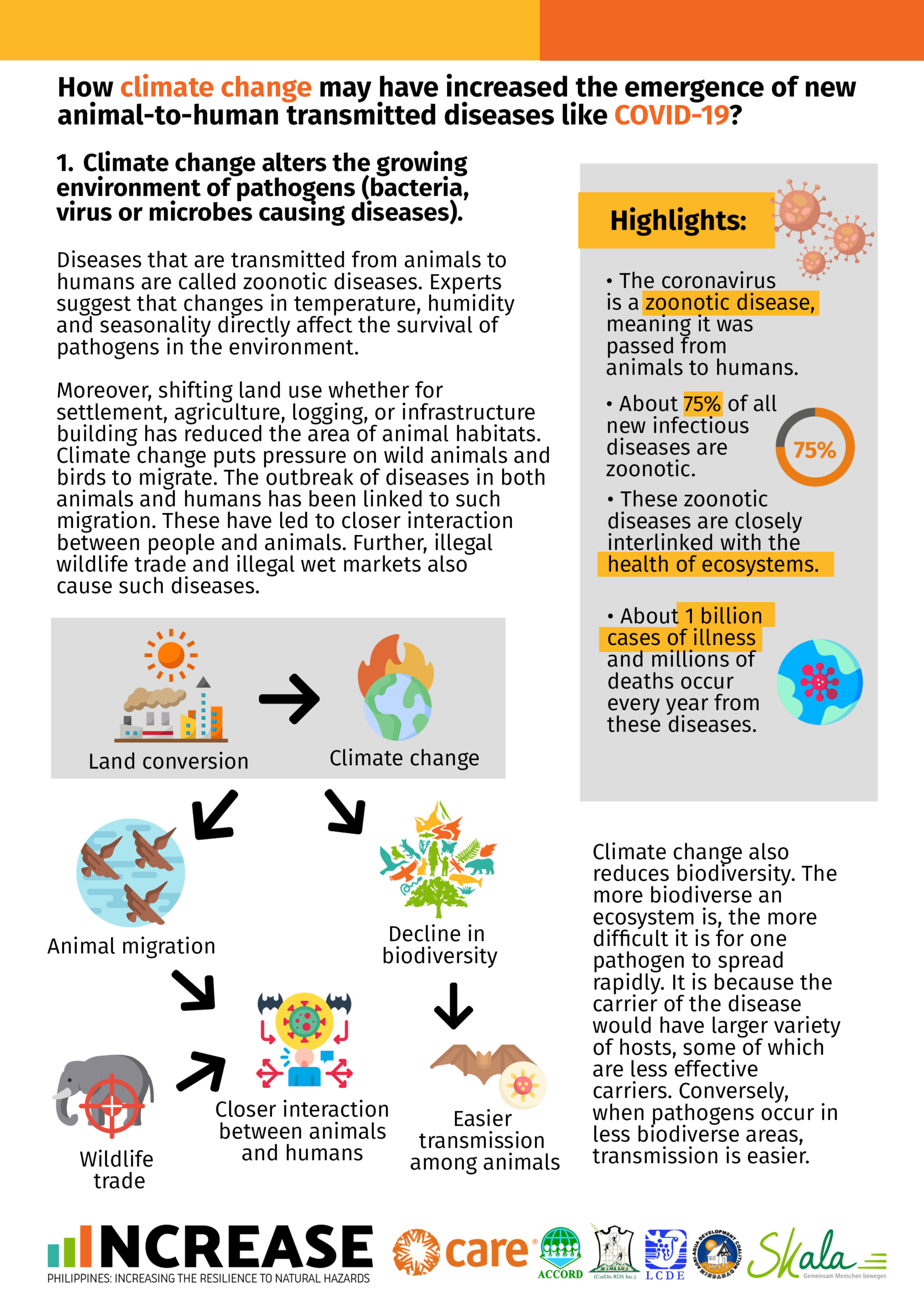
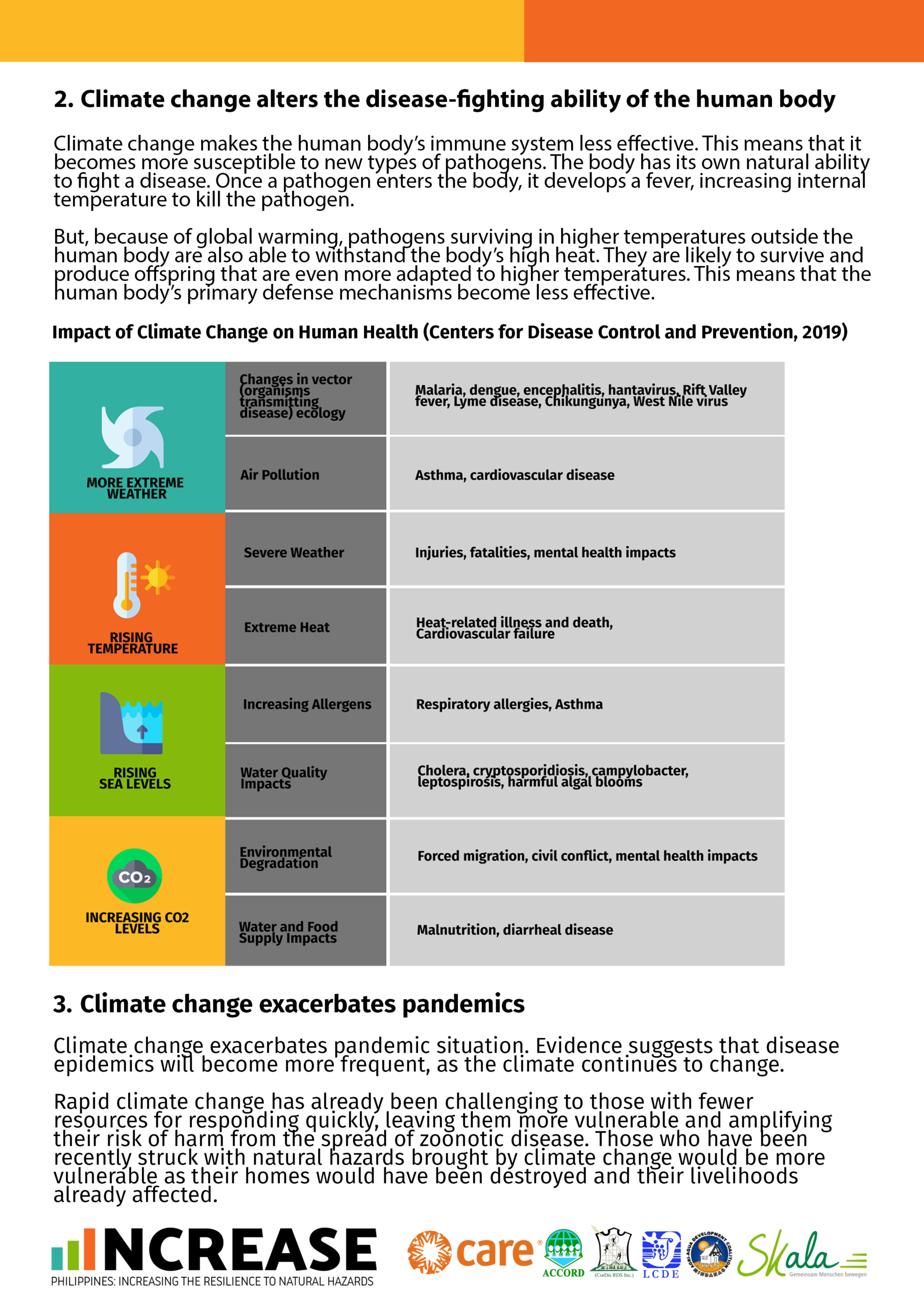
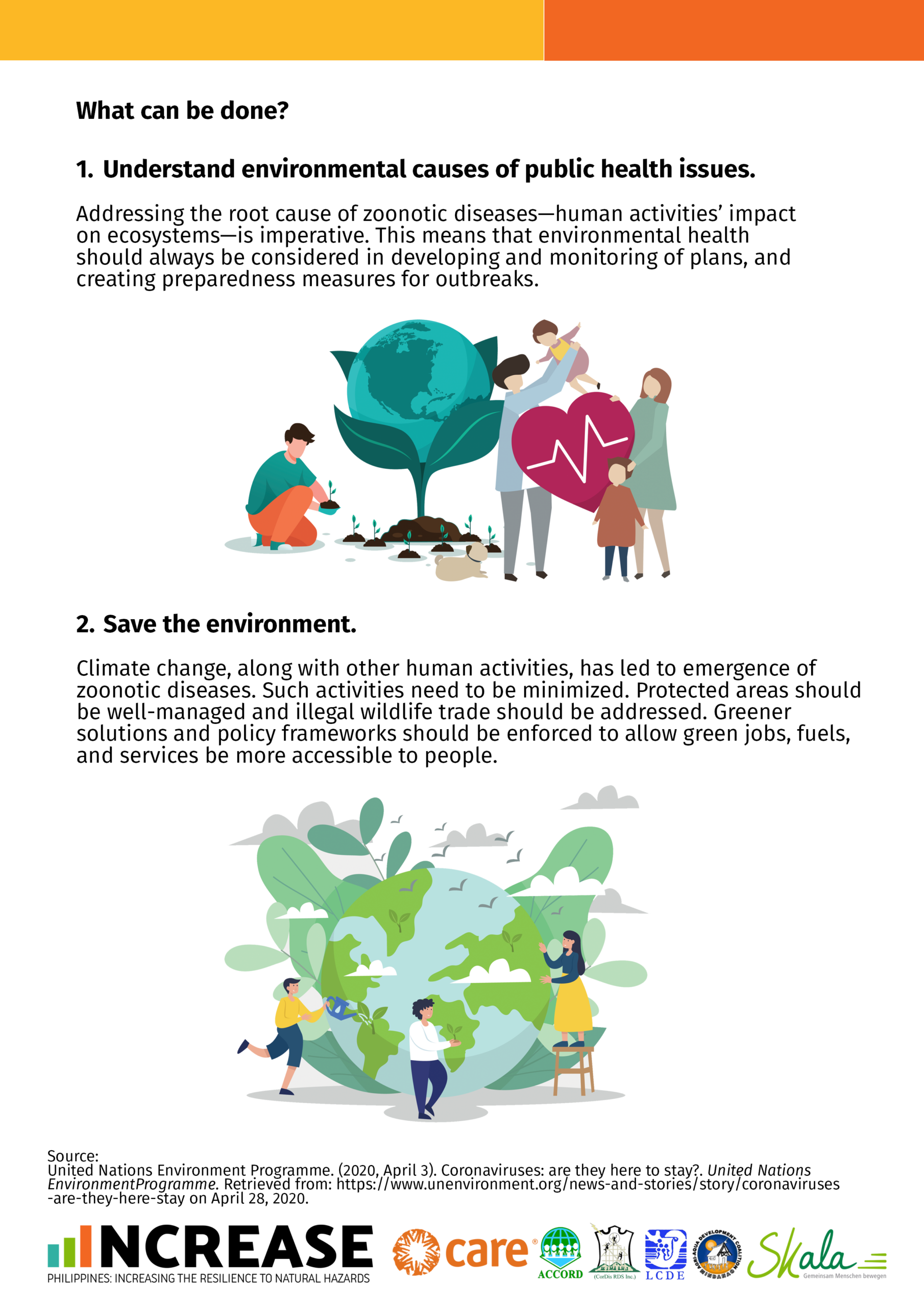
This summarizes the United Nations Environment Programme report on coronaviruses and explains the correlation between climate change and diseases. It also includes an infographic of the impact of climate change to human health and steps that people can collectively act on.
Click on the photos in the gallery below to enlarge and download a soft copy of these materails.