As the Philippines enters La Nina season, public advisories help in preparing communities. Specific agri-weather advisories were presented in these infographics for each INCREASE area.
Please refer to the advisories per area below:
INCREASE or “Philippines – Increasing Resilience to Natural Hazards” aims to increase the resilience of 45,00 women and men small scale farmers and fishers, including 720 extremely poor female-headed households, to natural hazards and the effect of climate change. The project will run from 2019-2021 in different parts of the Philippines, namely 36 barangays across 8 municipalities in the provinces of Cagayan, Mt. Province, Northern Samar, and Surigao del Sur. Its project components and activities include early warning systems, alternative livelihood, and climate and disaster governance.
This is an infographic of the latest public storm warning signal used by PAGASA. It aims to familiarize communities with the potential impact when any Public Storm Warning Signal Number is hoisted or put in effect in an area, and therefore make preparedness measures when a public storm hits.
Please use or access the file below if you would like to have it save a sot copy of the file.

INCREASE or “Philippines – Increasing Resilience to Natural Hazards” aims to increase the resilience of 45,00 women and men small scale farmers and fishers, including 720 extremely poor female-headed households, to natural hazards and the effect of climate change. The project will run from 2019-2021 in different parts of the Philippines, namely 36 barangays across 8 municipalities in the provinces of Cagayan, Mt. Province, Northern Samar, and Surigao del Sur. Its project components and activities include early warning systems, alternative livelihood, and climate and disaster governance.
Integrated Risk Management Training Manual (4 modules) Contents:
- Module 1: Community-Based Disaster Risk Management
- Module 2: Community Risk Assessment
- Module 3: Contingency Planning
- Module 4: Mainstreaming DRR, CCA, at EMR sa mga planong pangkaunlaran
This manual is written for facilitators who will conduct training in communities that are vulnerable to various hazards.
It may also be useful for members of disaster risk reduction and management bodies in schools and at the community, barangay, city, and municipal levels; and other non-government organizations.
It is written in Filipino and presents the technical subject matter in terms that are easily understandable, and in a format that is easily readable. Among other resources, it contains tools to conduct community risk assessments.
Register to access and download the modules here.
This companion guide to mainstreaming disaster risk reduction (DRR), climate change adaptation (CCA) and ecosystem management and restoration (EMR) in an integrated way is a product of many years of practice, reflection and learning. In 2012, ACCORD and CARE Nederland published a 3-volume Training on Disaster Preparedness and Contingency Planning manual. One session, on risk reduction planning, briefly touched on mainstreaming DRR, CCA and EMR in development plans. Today, we are transforming our accumulated knowledge on mainstreaming into this companion guide or handbook, with optimism that others will find value in, and learn from our experience.
CARE Nederland introduced to us the project cycle management approach to mainstreaming. The Bureau of Local Government Development of the Department of Interior and Local Government trained us on mainstreaming DRR and CCA in the Rationalized Planning System. For both, their support was crucial in the development of our mainstreaming practice. The local government units (LGUs) that have worked with us in the mainstreaming process are too numerous to acknowledge individually, but Saint Bernard, a municipality of Southern Leyte, and Calabanga in Camarines Sur deserve special mention. Led respectively by mayors Rico Rentuza and Evelyn Yu, Saint Bernard and Calabanga enthusiastically collaborated with us in our earliest attempt at mainstreaming. Equally valuable was our collaboration with the municipalities of Maragusan, Davao de Oro and La Paz, Leyte; the Metro Manila cities of Malabon and Navotas;
To view and download the full document, please click here.
This Manual was originally published in Filipino in 2009, bearing the title Pagsasanay sa Disaster Preparedness at Contingency Planning. The publication in Filipino was intentional. The targeted users of the manual were high-risk communities and local authorities in the Philippines. Moreover, the choice made by CARE and the Corporate Network for Disaster Response to propagate the community-based approach to disaster risk reduction dictated that the manual be published in Filipino.
Much has transpired since the manual’s publication in 2009. The manual was a product of the Strengthening Assets and Capacities of Communities and Local Governments for Resilience to Disasters (ACCORD) project. Two follow-up community-based disaster risk reduction projects have since been completed, also supported by the European Commission Humanitarian Aid and Civil Protection department (ECHO). A five-year community-based disaster risk reduction programme was also started in 2011, with funding from the Ministry of Foreign Affairs of The Netherlands. These projects have served to enrich the content of the training manual.
Aside from the foregoing explicit DRR projects, other projects implemented by CARE and partners CNDR, Cordillera Disaster Response and Development Services (CorDisRDS), Agri-Aqua Development Coalition (AADC) and Assistance and Cooperation for Community Resilience and Development (ACCORD Inc.) have used Pagsasanay sa Disaster Preparedness at Contingency Planning. Five emergency response projects since Ketsana (Ondoy) and a food security and livelihood project funded by the EuropeAid have used the manual as a means for mainstreaming DRR in emergency response. This experience likewise contributed to the enrichment of Pagsasanay.
Over three years of practical experience later, frameworks, approaches and concepts have clarified and evolved. Tools and learning methodologies have vastly improved. These developments required that Pagsasanay be updated. An updated Pagsasanay would feature the addition of sessions on climate change adaptation and ecosystem management and restoration. This is in recognition of present realities – that disasters are becoming more frequent and more destructive because of climate change and environmental degradation. These aspects were not present in the original manual. Other additions are the sessions on relevant DRR and CCA laws and the organization of functional Disaster Risk Reduction and Management Councils (DRRMCs). There were two push factors for these inclusions. One is the passage of the Philippine Disaster Risk Reduction and Management Act and the Climate Change Act.
The second factor is closely linked to the first: village, municipal and school authorities wanted to know more about the new laws and are requesting assistance for them to be able to comply with the provisions of the laws. So then why an English edition? Early on, there was already a demand for an English edition from those who do not read and speak Filipino. The lack of an English edition prevented the dissemination of the manual on a wider scale, within the Philippines and beyond.
Training on Disaster Preparedness and Contingency Planning is the response to the oft-received request for an English translation of the manual. Updating of the original manual in Filipino, and its translation and publication in English are a fulfilment of the obligation of CARE and partners to share what has been developed from experience and collaboration amongst high-risk communities and local authorities.
View and download the first module here.
This Manual was originally published in Filipino in 2009, bearing the title Pagsasanay sa Disaster Preparedness at Contingency Planning. The publication in Filipino was intentional. The targeted users of the manual were high-risk communities and local authorities in the Philippines. Moreover, the choice made by CARE and the Corporate Network for Disaster Response to propagate the community-based approach to disaster risk reduction dictated that the manual be published in Filipino.
Much has transpired since the manual’s publication in 2009. The manual was a product of the Strengthening Assets and Capacities of Communities and Local Governments for Resilience to Disasters (ACCORD) project. Two follow-up community-based disaster risk reduction projects have since been completed, also supported by the European Commission Humanitarian Aid and Civil Protection department (ECHO). A five-year community-based disaster risk reduction programme was also started in 2011, with funding from the Ministry of Foreign Affairs of The Netherlands. These projects have served to enrich the content of the training manual.
Aside from the foregoing explicit DRR projects, other projects implemented by CARE and partners CNDR, Cordillera Disaster Response and Development Services (CorDisRDS), Agri-Aqua Development Coalition (AADC) and Assistance and Cooperation for Community Resilience and Development (ACCORD Inc.) have used Pagsasanay sa Disaster Preparedness at Contingency Planning. Five emergency response projects since Ketsana (Ondoy) and a food security and livelihood project funded by the EuropeAid have used the manual as a means for mainstreaming DRR in emergency response. This experience likewise contributed to the enrichment of Pagsasanay.
Over three years of practical experience later, frameworks, approaches and concepts have clarified and evolved. Tools and learning methodologies have vastly improved. These developments required that Pagsasanay be updated. An updated Pagsasanay would feature the addition of sessions on climate change adaptation and ecosystem management and restoration. This is in recognition of present realities – that disasters are becoming more frequent and more destructive because of climate change and environmental degradation. These aspects were not present in the original manual. Other additions are the sessions on relevant DRR and CCA laws and the organization of functional Disaster Risk Reduction and Management Councils (DRRMCs). There were two push factors for these inclusions. One is the passage of the Philippine Disaster Risk Reduction and Management Act and the Climate Change Act.
The second factor is closely linked to the first: village, municipal and school authorities wanted to know more about the new laws and are requesting assistance for them to be able to comply with the provisions of the laws. So then why an English edition? Early on, there was already a demand for an English edition from those who do not read and speak Filipino. The lack of an English edition prevented the dissemination of the manual on a wider scale, within the Philippines and beyond.
Training on Disaster Preparedness and Contingency Planning is the response to the oft-received request for an English translation of the manual. Updating of the original manual in Filipino, and its translation and publication in English are a fulfilment of the obligation of CARE and partners to share what has been developed from experience and collaboration amongst high-risk communities and local authorities.
View and download the first module here.
This Manual was originally published in Filipino in 2009, bearing the title Pagsasanay sa Disaster Preparedness at Contingency Planning. The publication in Filipino was intentional. The targeted users of the manual were high-risk communities and local authorities in the Philippines. Moreover, the choice made by CARE and the Corporate Network for Disaster Response to propagate the community-based approach to disaster risk reduction dictated that the manual be published in Filipino.
Much has transpired since the manual’s publication in 2009. The manual was a product of the Strengthening Assets and Capacities of Communities and Local Governments for Resilience to Disasters (ACCORD) project. Two follow-up community-based disaster risk reduction projects have since been completed, also supported by the European Commission Humanitarian Aid and Civil Protection department (ECHO). A five-year community-based disaster risk reduction programme was also started in 2011, with funding from the Ministry of Foreign Affairs of The Netherlands. These projects have served to enrich the content of the training manual.
Aside from the foregoing explicit DRR projects, other projects implemented by CARE and partners CNDR, Cordillera Disaster Response and Development Services (CorDisRDS), Agri-Aqua Development Coalition (AADC) and Assistance and Cooperation for Community Resilience and Development (ACCORD Inc.) have used Pagsasanay sa Disaster Preparedness at Contingency Planning. Five emergency response projects since Ketsana (Ondoy) and a food security and livelihood project funded by the EuropeAid have used the manual as a means for mainstreaming DRR in emergency response. This experience likewise contributed to the enrichment of Pagsasanay.
Over three years of practical experience later, frameworks, approaches and concepts have clarified and evolved. Tools and learning methodologies have vastly improved. These developments required that Pagsasanay be updated. An updated Pagsasanay would feature the addition of sessions on climate change adaptation and ecosystem management and restoration. This is in recognition of present realities – that disasters are becoming more frequent and more destructive because of climate change and environmental degradation. These aspects were not present in the original manual. Other additions are the sessions on relevant DRR and CCA laws and the organization of functional Disaster Risk Reduction and Management Councils (DRRMCs). There were two push factors for these inclusions. One is the passage of the Philippine Disaster Risk Reduction and Management Act and the Climate Change Act.
The second factor is closely linked to the first: village, municipal and school authorities wanted to know more about the new laws and are requesting assistance for them to be able to comply with the provisions of the laws. So then why an English edition? Early on, there was already a demand for an English edition from those who do not read and speak Filipino. The lack of an English edition prevented the dissemination of the manual on a wider scale, within the Philippines and beyond.
Training on Disaster Preparedness and Contingency Planning is the response to the oft-received request for an English translation of the manual. Updating of the original manual in Filipino, and its translation and publication in English are a fulfilment of the obligation of CARE and partners to share what has been developed from experience and collaboration amongst high-risk communities and local authorities.
View and download the first module here.
This Manual was originally published in Filipino in 2009, bearing the title Pagsasanay sa Disaster Preparedness at Contingency Planning. The publication in Filipino was intentional. The targeted users of the manual were high-risk communities and local authorities in the Philippines. Moreover, the choice made by CARE and the Corporate Network for Disaster Response to propagate the community-based approach to disaster risk reduction dictated that the manual be published in Filipino.
Much has transpired since the manual’s publication in 2009. The manual was a product of the Strengthening Assets and Capacities of Communities and Local Governments for Resilience to Disasters (ACCORD) project. Two follow-up community-based disaster risk reduction projects have since been completed, also supported by the European Commission Humanitarian Aid and Civil Protection department (ECHO). A five-year community-based disaster risk reduction programme was also started in 2011, with funding from the Ministry of Foreign Affairs of The Netherlands. These projects have served to enrich the content of the training manual.
Aside from the foregoing explicit DRR projects, other projects implemented by CARE and partners CNDR, Cordillera Disaster Response and Development Services (CorDisRDS), Agri-Aqua Development Coalition (AADC) and Assistance and Cooperation for Community Resilience and Development (ACCORD Inc.) have used Pagsasanay sa Disaster Preparedness at Contingency Planning. Five emergency response projects since Ketsana (Ondoy) and a food security and livelihood project funded by the EuropeAid have used the manual as a means for mainstreaming DRR in emergency response. This experience likewise contributed to the enrichment of Pagsasanay.
Over three years of practical experience later, frameworks, approaches and concepts have clarified and evolved. Tools and learning methodologies have vastly improved. These developments required that Pagsasanay be updated. An updated Pagsasanay would feature the addition of sessions on climate change adaptation and ecosystem management and restoration. This is in recognition of present realities – that disasters are becoming more frequent and more destructive because of climate change and environmental degradation. These aspects were not present in the original manual. Other additions are the sessions on relevant DRR and CCA laws and the organization of functional Disaster Risk Reduction and Management Councils (DRRMCs). There were two push factors for these inclusions. One is the passage of the Philippine Disaster Risk Reduction and Management Act and the Climate Change Act.
The second factor is closely linked to the first: village, municipal and school authorities wanted to know more about the new laws and are requesting assistance for them to be able to comply with the provisions of the laws. So then why an English edition? Early on, there was already a demand for an English edition from those who do not read and speak Filipino. The lack of an English edition prevented the dissemination of the manual on a wider scale, within the Philippines and beyond.
Training on Disaster Preparedness and Contingency Planning is the response to the oft-received request for an English translation of the manual. Updating of the original manual in Filipino, and its translation and publication in English are a fulfillment of the obligation of CARE and partners to share what has been developed from experience and collaboration amongst high-risk communities and local authorities.
View and download the first module here.
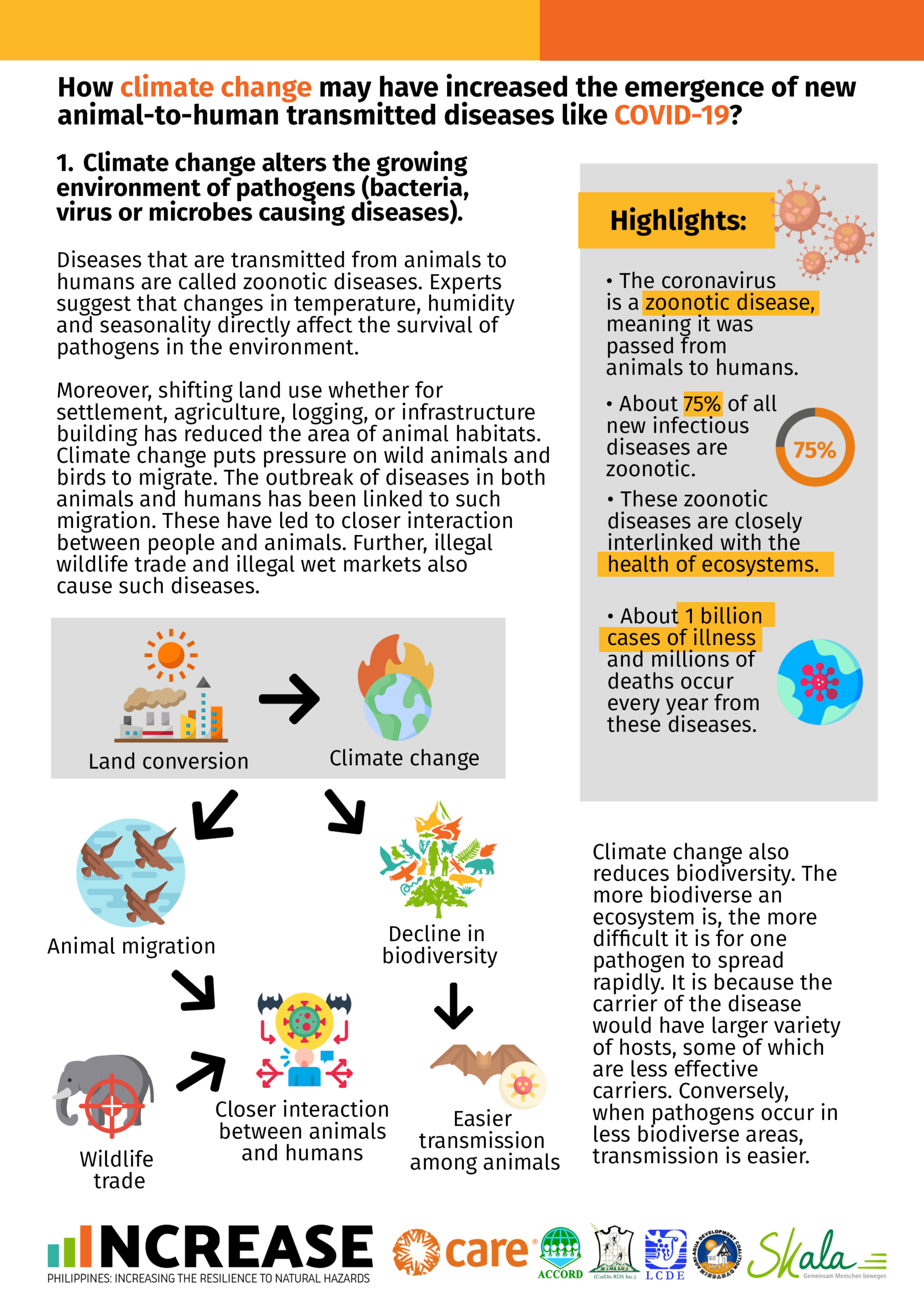
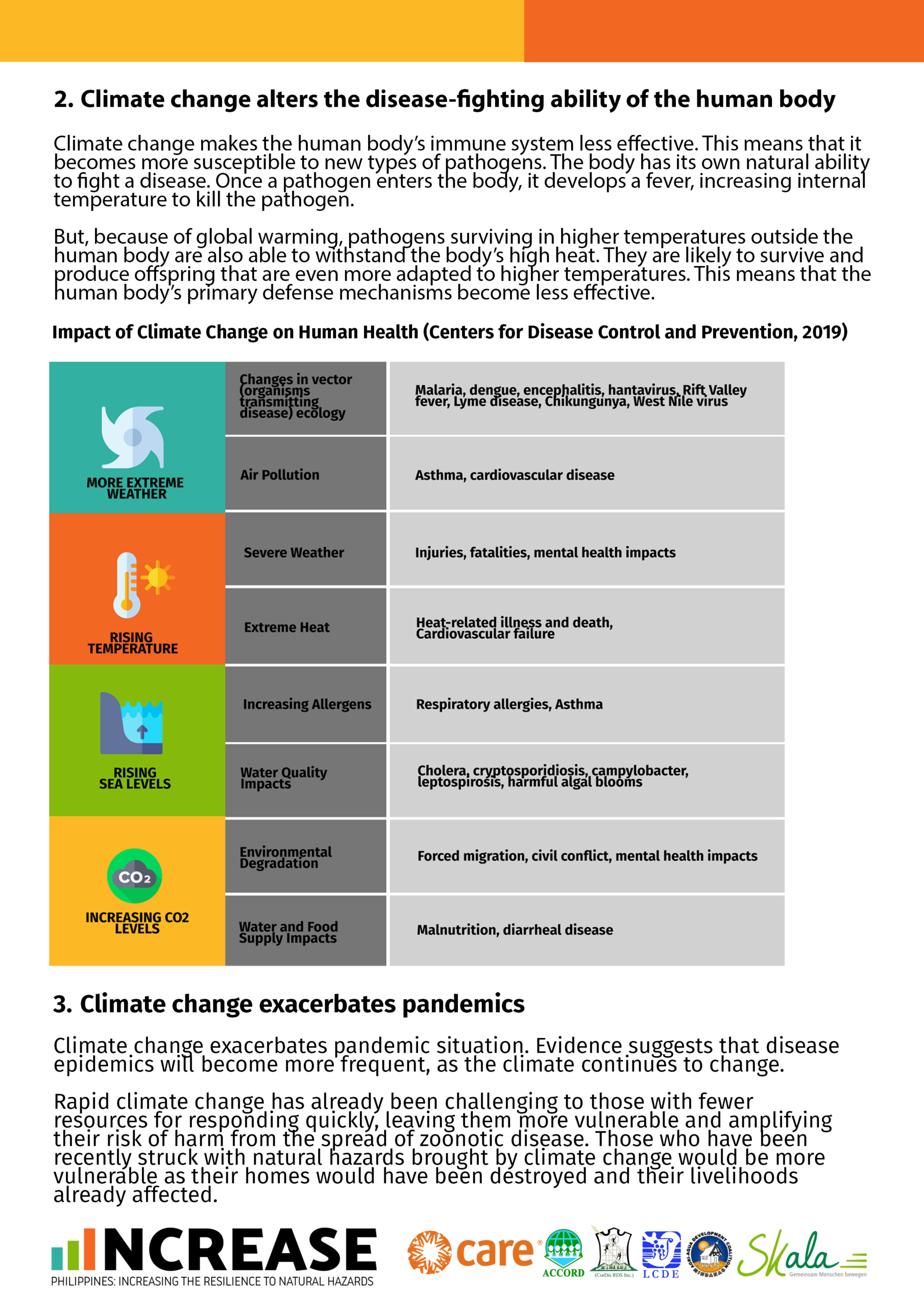
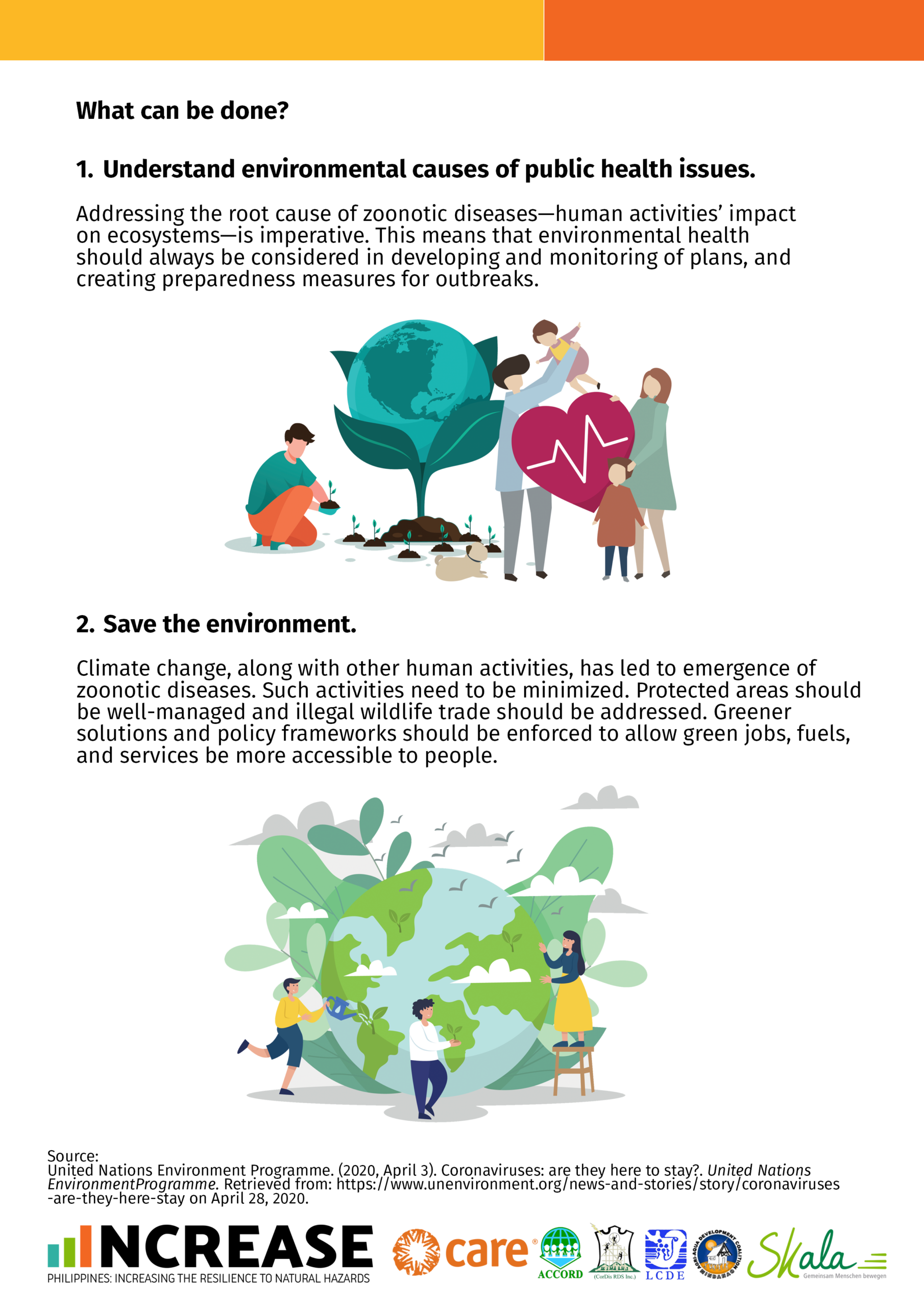
This summarizes the United Nations Environment Programme report on coronaviruses and explains the correlation between climate change and diseases. It also includes an infographic of the impact of climate change to human health and steps that people can collectively act on.
Click on the photos in the gallery below to enlarge and download a soft copy of these materails.
As the Hyogo Framework for Action (HFA) draws to an end and disaster-related loss and damage continues to increase, an important opportunity arises to shape and agree upon a successor framework that will enable management of the risks that threaten to reverse vital development gains. These risks are driven by a variety of factors (UNISDR 2013) including climate variability and change, economic and financial crises, environmental mismanagement, demographic change, rapid and unplanned urbanization, and failed governance; they disproportionately impact vulnerable and exposed low-income households around the world.
As the HFA Priority area 4 refers to disaster risk reduction (DRR) strategies integrated with climate change adaptation and lists among the “critical tasks for states” to promote the integration of DRR with climate variability and climate change into DRR strategies and adaptation to climate change, considerable effort has been made by agencies to work towards convergence of the DRR and the climate change adaptation agendas. However, despite the obvious overlap, these two agendas have evolved independently and in parallel (Mitchell & van Aalst 2008, Mitchell et al. 2010, Mercer 2010) and have faced different challenges (e.g. Schipper & Pelling 2006). In terms of practical programming, there has perhaps been some risk of “relabelling” classical DRR efforts addressing weather-related risks without consciously incorporating concerns for the change in risk patterns, extreme events and vulnerability partly induced by climate change. In addition, there has been a tendency to initiate stand-alone climate change adaptation (CCA) projects disregarding existing vulnerabilities, in effect “overstating” the adaptation aspects of the project rather than integrating adaptation measures into existing approaches, as recommended in the HFA.
Since the HFA in 2005 more compelling evidence about how climate change has – and continues to – influence disaster risk has emerged (including IPCC AR4 and AR5 and SREX). At the same time, many implementing agencies, in particular civil society organizations, have developed and tested various approaches and tools to integrate climate aspects in (participatory) assessments and planning (IIRR Cordaid 2013, CARE 2009, Wiggins 2012) and considerable effort has been made to bounce ideas and share knowledge across agencies about tools and methods for integrating changing climate risks into DRR through for example, the Community Based Adaptation to Climate Change Conferences, and Development & Climate Days held in the context of the annual UNFCCC Conference of Parties (Bachofen et al 2014, Suarez et al 2013). Through these iterations, some common denominators for climate-smart community programming have started to emerge.
Pilot projects across the world have shown that addressing changing climate and disaster risks at the local level is highly effective for building resilience. Strong capacities and robust institutions at the community level can maximize the impacts of climate-smart disaster risk reduction. Yet for this to happen, it is essential that communities and the organizations supporting them all know how to integrate changing risks into their activities.
While empowering communities and the local organizations that support them to become better at managing their risk, the disaster risk reduction community faces increasing pressure to deliver on a greater scale, and help local actors steer their development trajectories upwards. At the same time, policymakers seek clarity and guidance from practitioners on the standards to set for local climate change adaptation efforts – a crucial component of national adaptation planning. Taken together, these demands call for a simplified set of criteria to ensure community-based DRR programming, as well as broader resilience-building efforts, can guide communities and the organizations supporting them.
To address this growing demand, the Minimum Standards for Local Climate-smart Disaster Risk Reduction (hereafter referred to as “Minimum Standards”) have been developed to provide a ‘good enough guide’ to help local community leaders, DRR practitioners and policymakers ensure DRR efforts are geared to more uncertain future risk patterns induced by a changing climate. The Minimum Standards are meant to serve as a useful guide for planners and donors as well so they may ensure DRR programming is meeting CCA needs and that DRR actions are going beyond business as usual by truly addressing changing climate-related risks. Indeed, recognizing that the Minimum Standards are realistic and achievable, national strategies that consider them will be able to go to scale, also in facilitating the use of climate adaptation finance for local efforts to reduce the rising risk of disaster in a changing climate.
This paper presents the Minimum Standards for local climate-smart disaster risk reduction and details how they can help trigger action on climate change under the post-2015 HFA framework. The first section provides an overview of the Minimum Standards and their relevance for guiding climate-smart action at the community level and at the civil society organisation (CSO) level. The second section presents experience of community level application of the Minimum Standards in the Philippines, Indonesia, and India in the context of the Partners for Resilience Program. To illustrate how the Minimum Standards have been used to strengthen CSO’s capacity to become climate-smart, the third section details the experience of the Vanuatu Red Cross and suggests for this approach to be replicated by other CSOs. In addition, the process by which Australian Red Cross has expanded the Minimum Standards to include gender dimensions of DRR is presented in a final case study. The paper concludes with a discussion of the way forward for maximizing the opportunities to use the Minimum Standards to inform the development of the post 2015 HFA.