The climate outlook for February-April 2021 was based on PAGASA Climate Forum. This contains the compiled relevant climate information for INCREASE areas and are sent to each specific municipality. This can be used as a guide to planning out activities including food production so climate-related risks are reduced. This is updated every quarter.
Below you may find a gallery of photos detailing the climate outlook for the said period. There are also area-specific versions of the material. You may click on each photo to enlarge it or access the download link.
Story by: Agri-Aqua Development Coalition
Jovelyn Malinao, 49 years old, has been Brgy. Gamut’s Chairperson since 2013, after serving as a Barangay Councilor for 9 years. But unlike other public servants with aspirations of public service, Jovelyn never imagined that she can lead a barangay. “Before, I was shy as I was a mere housewife. I don’t usually talk to people. I prefer to stay at home, take care of my children, do our chores like washing our clothes, and take care of my husband,” said Jovelyn. It was only after her friends and other individuals in the barangay have encouraged her that the thought came to her mind. She finally decided to run for public office when her husband also told her, “Go and try it.”
Jovelyn understands the barriers that women have to go through to become leaders. “Before, leadership is only for men,” said Jovelyn. Women face challenges and could not easily participate in community activities. “First, women are hindered from participating in community activities when there’s no support coming from the family, especially when the husband doesn’t give consent. Secondly, women always think of the family’s livelihood first. When they don’t have enough income to support the family, they prioritize the family’s needs and they can’t participate in community activities. Thirdly, women want to focus more on their children and their needs.”
Jovelyn may relate to the challenges to women’s community participation but strongly feels the need to serve their barangay. She knows that a woman leader and women, in general, can do more. “I believe that both sexes have the same concern for constituents. But, I think it is best that we give women a chance to become leaders because women can easily encourage participation from the community. It can be compared to a home when children would run to their mothers when they have problems because mothers are empathetic and understanding,” she shared.
To overcome these challenges, women leaders must step up and encourage the participation of other women in community activities. Jovelyn focused her efforts on information education campaigns and communal learning activities such as trainings, seminars, and workshops. She personally went to the women in her barangay to motivate them to join in these activities. For her, everyone should know that women have equal rights as men in accessing opportunities. “It is important to make women understand that they have rights to lift up themselves and for the men to know that they should not hinder what the women want to achieve,” said Jovelyn. Because of Jovelyn’s efforts, along with the support of her barangay council, more women in Brgy. Gamut participate in community activities and also take leadership roles.
Brgy. Gamut, in Barobo, Surigao del Sur, is one of the barangays supported by Philippines: Increasing the Resilience to Natural Hazards (INCREASE). INCREASE aims to increase the resilience of 45,000 women and men small-scale farmers and fishers, including 720 extreme poor female-headed households, to natural hazards and the effects of climate change. This project is implemented by CARE Philippines, together with Assistance and Cooperation for Community Resilience and Development, Inc (ACCORD), Cordillera Disaster Response and Development Services (CORDIS), Leyte Center for Development, Inc (LCDE), and Agri-Aqua Development Coalition – Mindanao (AADC), through the support of SKala Initiatives of Germany.
The COVID-19 Pandemic brought about multiple challenges that none of us were able to foresee. Aside from the great panic and risk, many people were put in uncomfortable positions when the world seemed to pause and turn quiet. Streets were empty, people lost their jobs, and vulnerable communities were put at an even greater risk. Moreover, one thing that did not stop were various natural calamities such as floods and typhoons, especially in the Philippines.
As an adaptive measure to the logistical limitations brought about by the COVID-19 Pandemic, RILHUB, together with its partners, decided to continue its capacity-building efforts through online and virtual means. Thus, the Resilience Knowledge Exchange Series was launched in June of 2020.
Since then, RILHUB was able to implement a total of eight (8) sessions of the Resilience Knowledge Exchange Series otherwise referred to as RKES.
Although each RKES tackled different topics or subject matter, all sessions aimed to increase the resilience and capacity building of RILHUB communities and partners. To continue learning and the exchange of best practices, organizations and agencies outside RILHUB’s founding organizations were also engaged. Among valued RILHUB collaborations and partnerships in 2020 include the following organizations and agencies:
- Department of Health
- Marikina City Local Government, Metro Manila
- Malabon City Local Government, Metro Manila
- United Architects of the Philippines – Emergency Architects
- Philippine Atmospheric, Geophysical and Astronomical Services Administration (PAGASA)
- Valenzuela City Local Government, Metro Manila
- Quezon City Local Government, Metro Manila
- Department of Social Welfare and Development (DSWD) and the DSWD Disaster Response Management Bureau
- Department of Interior and Local Government (DILG) Local Government Academy
- Office of Civil Defense (OCD)
- Bago City Local Government, Negros Occidental
- Oxfam
- Plan International
- Asmae Association Soeaur Emmanuelle
- Childhope
- Kanlungan sa Er-Ma Ministries
- Redemptorist Church
- UP Philippine General Hospital
- Barangay 28 Local Government, Caloocan City, Metro Manila
- Department of Environment and Natural Resources
- Pambansang Koalisyon ng Kababaihan sa Kanayunan (PKKK)

From June of 2020, the RILHUB online community has now grown to over 2,ooo individuals. RILHUB is incredibly grateful to all the organizations, agencies, and communities who became a part of the RILHUB community in one way or the other. This year, we look forward to strengthening existing and forging newer partnerships as we continue striving to become an accessible and engaging platform that advocates for resilience and integrated risk management to build the resilience and capacity-building efforts of its partners and communities.
This is an infographic of the latest public storm warning signal used by PAGASA. It aims to familiarize communities with the potential impact when any Public Storm Warning Signal Number is hoisted or put in effect in an area, and therefore make preparedness measures when a public storm hits.
Please use or access the file below if you would like to have it save a sot copy of the file.

INCREASE or “Philippines – Increasing Resilience to Natural Hazards” aims to increase the resilience of 45,00 women and men small scale farmers and fishers, including 720 extremely poor female-headed households, to natural hazards and the effect of climate change. The project will run from 2019-2021 in different parts of the Philippines, namely 36 barangays across 8 municipalities in the provinces of Cagayan, Mt. Province, Northern Samar, and Surigao del Sur. Its project components and activities include early warning systems, alternative livelihood, and climate and disaster governance.
What is resilient livelihood? This infographic aims to acquaint readers to examples and unique characteristics of resilient livelihood and how
INCREASE project will support its establishment in its project areas.

INCREASE or “Philippines – Increasing Resilience to Natural Hazards” aims to aims to increase the resilience of 45,00 women and men small scale farmers and fishers, including 720 extremely poor female-headed households, to natural hazards and the effect of climate change. The project will run from 2019-2021 in different parts of the Philippines, namely 36 barangays across 8 municipalities in the provinces of Cagayan, Mt. Province, Northern Samar, and Surigao del Sur. Its project components and activities include early warning systems, alternative livelihood, and climate and disaster governance.
In the field, INCREASE team has received the following questions from government agencies and military forces. The document lists these questions and corresponding answers relating to INCREASE, giving basic information about the project.
Click on the photos to enlarge and access the file that may be downloaded.


INCREASE or “Philippines – Increasing Resilience to Natural Hazards” aims to aims to increase the resilience of 45,00 women and men small scale farmers and fishers, including 720 extremely poor female-headed households, to natural hazards and the effect of climate change. The project will run from 2019-2021 in different parts of the Philippines, namely 36 barangays across 8 municipalities in the provinces of Cagayan, Mt. Province, Northern Samar, and Surigao del Sur. Its project components and activities include early warning systems, alternative livelihood, and climate and disaster governance.
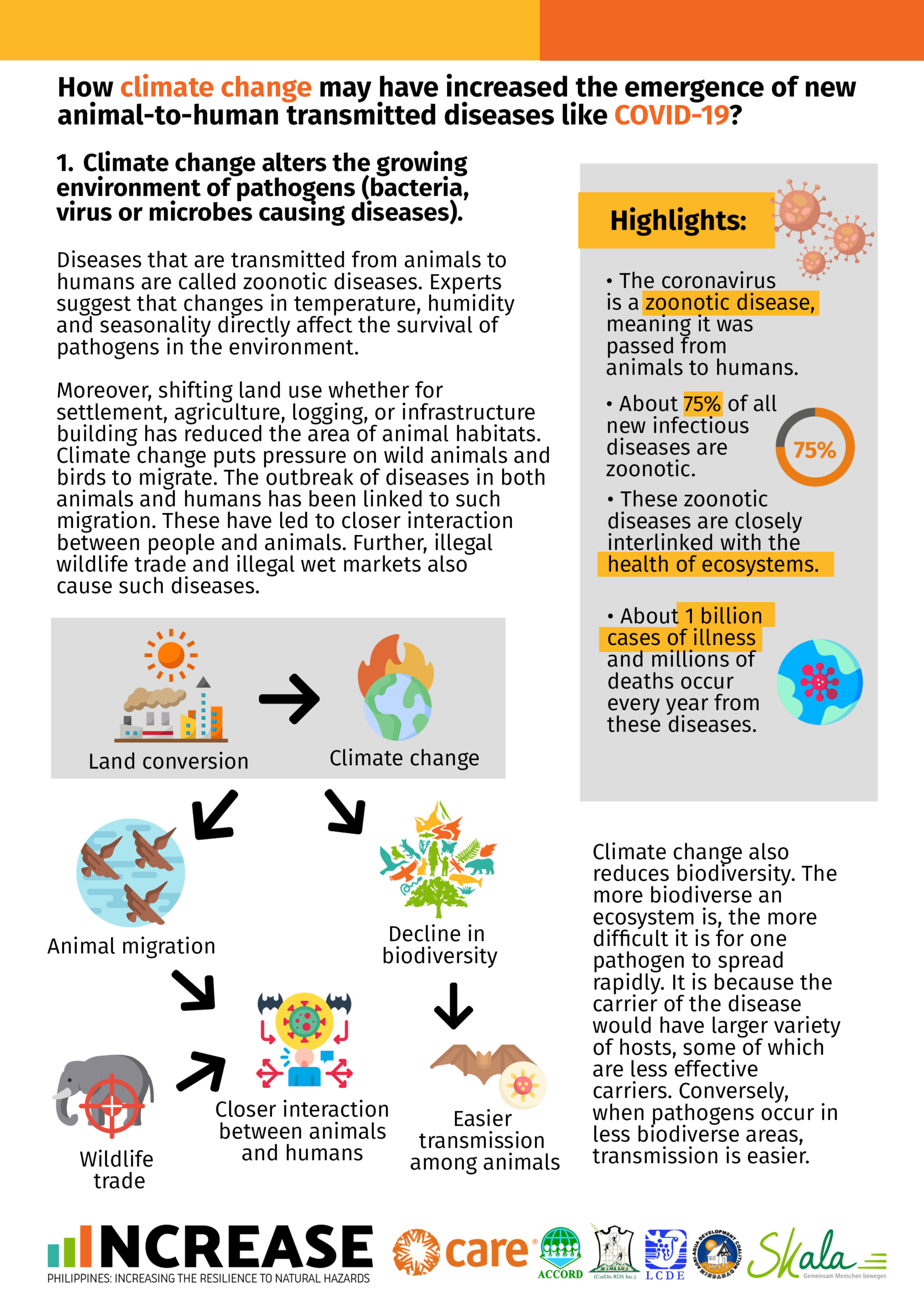
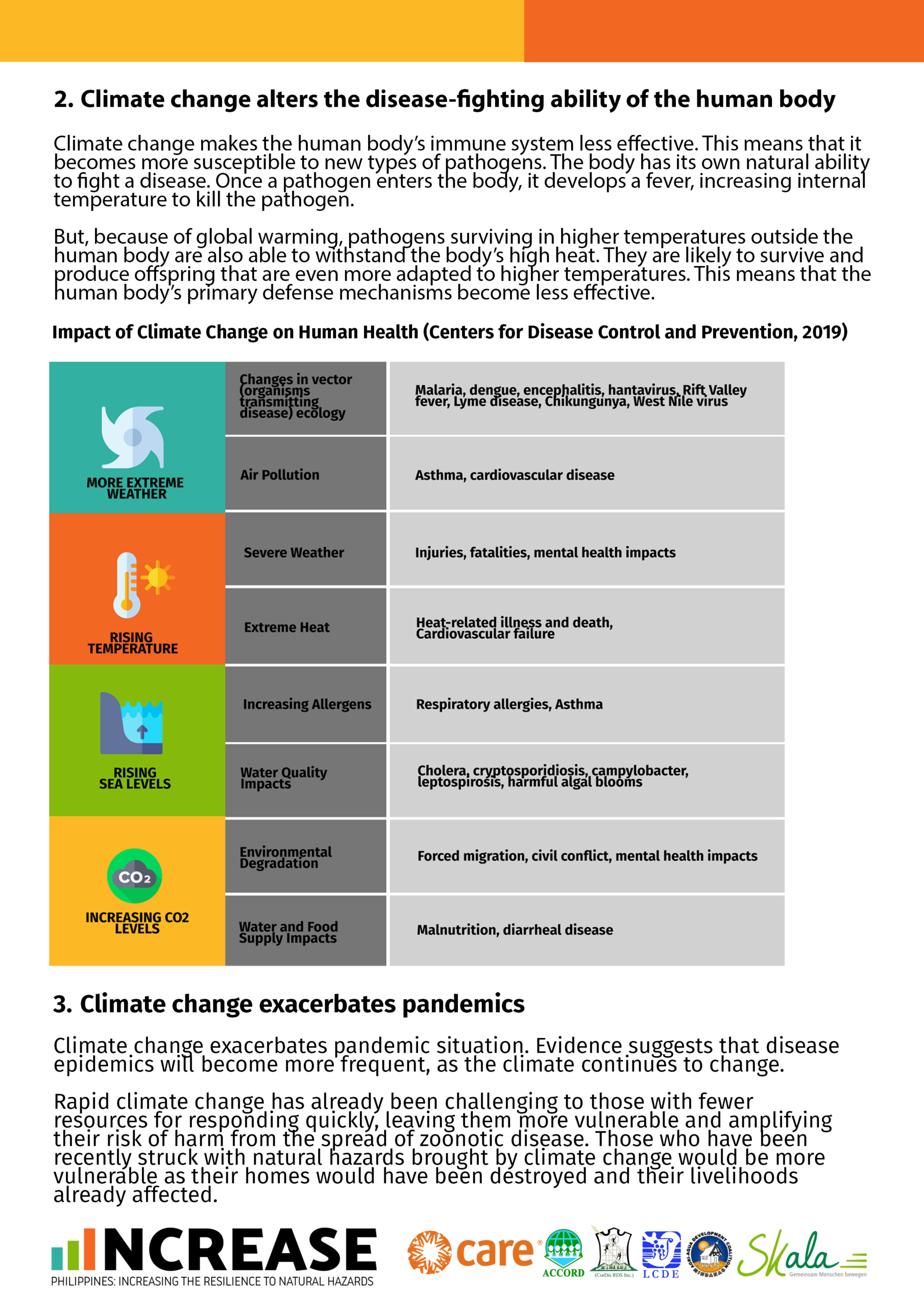
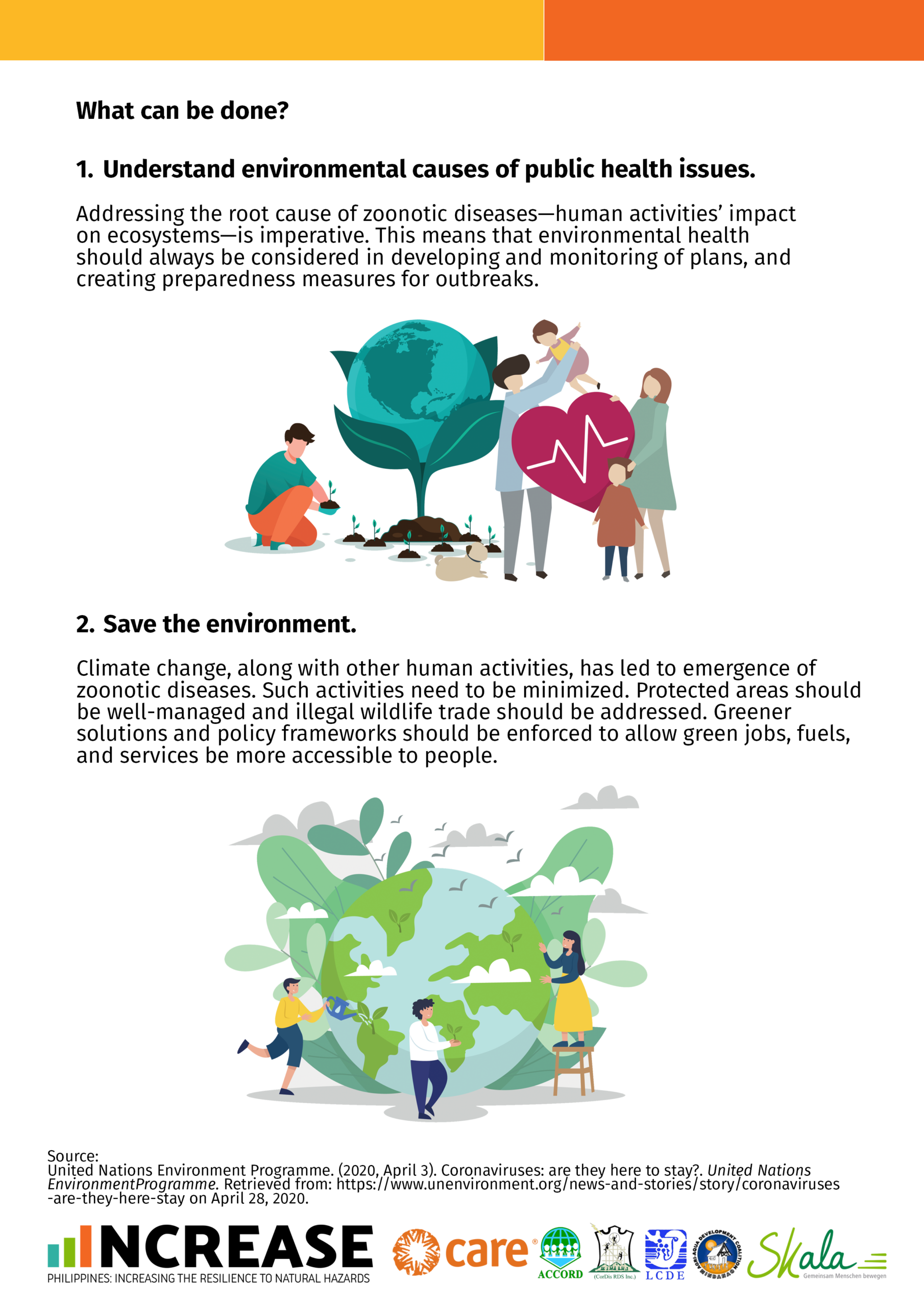
This summarizes the United Nations Environment Programme report on coronaviruses and explains the correlation between climate change and diseases. It also includes an infographic of the impact of climate change to human health and steps that people can collectively act on.
Click on the photos in the gallery below to enlarge and download a soft copy of these materails.
The climate outlook for June-August 2020 was based on PAGASA Climate Forum. This contains the compiled relevant climate information for INCREASE areas and are sent to each specific municipality. This can be used as a guide to plan out activities including food production so climate-related risks are reduced. This is updated every quarter.
Below you may find a gallery of photos detailing the climate outlook for the said period. There are also area-specific versions of the material. You may click on each photo to enlarge it or access the download link.


These guidelines come from the Department of Health which is intended for all Filipinos, whether owning a business, running a school, or driving a public utility vehicle, or an individual going to these places, to reduce our risk of exposure to the virus that causes COVID-19. It is in Filipino language and comes with visual aids, so they can be easily digested by readers.
View and download a copy of the posters through this link.
INCREASE or “Philippines – Increasing Resilience to Natural Hazards” aims to aims to increase the resilience of 45,00 women and men small scale farmers and fishers, including 720 extremely poor female-headed households, to natural hazards and the effect of climate change. The project will run from 2019-2021 in different parts of the Philippines, namely 36 barangays across 8 municipalities in the provinces of Cagayan, Mt. Province, Northern Samar, and Surigao del Sur. Its project components and activities include early warning systems, alternative livelihood, and climate and disaster governance.
Based on the released public health standards of the Department of Health, this infographic aims to remind INCREASE communities of the simple steps they can do at home to prevent getting sick.
You may save the image below to have a copy of this material.

INCREASE or “Philippines – Increasing Resilience to Natural Hazards” aims to aims to increase the resilience of 45,00 women and men small scale farmers and fishers, including 720 extremely poor female-headed households, to natural hazards and the effect of climate change. The project will run from 2019-2021 in different parts of the Philippines, namely 36 barangays across 8 municipalities in the provinces of Cagayan, Mt. Province, Northern Samar, and Surigao del Sur. Its project components and activities include early warning systems, alternative livelihood, and climate and disaster governance.