by CorDisRDS, Inc.
The Cordillera Disaster Response & Development Services Inc (CorDisRDS Inc.) is a non-government organization providing disaster response and community development services to the communities of Cordillera Provinces: Apayao, Kalinga, Abra, Mountain Province, Ifugao, Benguet, and Baguio City. Their main activities include facilitating assistance to disaster-affected communities and helping in the distribution of relief assistance, giving training and seminars to capacitate community and people’s organization leaders and their members.
Support given by CARE:
CorDis-RDS is the local partner of CARE Philippines in implementing INCREASE project in Mountain Province. INCREASE or Increasing the Resilience to Natural Hazards aims to increase the resilience of
45,000 women and men small-scale farmers and fishers, including 720 extreme poor female-headed households, to natural hazards and the effects of climate change.
During the COVID-19 pandemic, CARE Philippines and CorDis-RDS, has provided personal protective equipment to municipal local government units (MLGUs) and sacks of rice as a relief to communities in Barlig and Natonin, Mountain Province.
COVID-19 information materials were also distributed in the areas to promote preventive measures against the coronavirus
The Problem
What has been your experience since the COVID-19 pandemic started?
The CorDis-RDS team has experienced challenges in reaching the communities because of travel restrictions. Before community quarantine was implemented, the team would spend 2 weeks in INCREASE areas where they would visit 4 barangays in two municipalities. But because of the pandemic, they had to cut their field work short to one and a half week covering three barangays. Since then, they were not able to go back to these communities.
According to Liza Lomong-ey, CorDis-RDS Field Officer, “Since the declaration of enhanced community quarantine in March 2020, it has been so stressful because the team was not able to personally reach partner communities and local government units (LGUs) in this trying time and we have not implemented activities for almost 6 months and are confined within our homes and office due to the safety protocols being implemented.”
How have you adapted operations to reach your beneficiaries?
The pandemic has heightened the importance of network-building, especially on the ground, in implementing emergency response and development projects. While faced with travel restrictions, the team has worked on strengthening their relationship with people’s organizations and LGUs so they can understand the evolving needs of the communities.
Liza mentioned, “Communication between INCREASE team and partner LGUs was sustained through constant updating and coordination via phone calls and text messages. From constant updating with MLGUs and partner BLGUs, COVID responses in Natonin and Barlig namely the provision of PPES and rice assistance were implemented. This was made possible through building partnerships with LGUs and their willingness to implement such.”
It is also important to keep the response strategy adaptive to the changing situations in the communities. For example, Barlig and Natonin are in the same province but follow different process in implementing relief distribution.
Liza shared, “The distribution of PPEs and sacks of rice were implemented by the municipal disaster risk reduction officer. Particular for the PPEs in Barlig and Natonin, it was channeled to the PDRRM office which was later fetched personally by Barlig MDRRM officer together with the PPEs for Natonin. Likewise, the rice distribution in the municipality was implemented under the supervision of Barlig Mayor’s office and MDRRM officer. In Natonin, the distribution was implemented directly by partner BLGUs.”

Since face-to-face interaction was not possible for CorDis-RDS team, they have supplemented the efforts of the LGUs with localized communication materials. This way, the communities would have reference materials for long term preventive measures as a community against COVID-19.
“We were also able to reach our partners through sending a localized IEC material on reminders for COVID 19 to 6 communities in Natonin and a minimal copy of COVID flyers (long term measures) to selected LGUs in the municipality,” said Liza.
What has been the ‘word on the ground’?
Community lockdowns were implemented by the government, limiting people’s movement and livelihood options. This has negatively affected their income as several businesses have closed either temporarily or permanently. A lot of people have lost their jobs, while farmers couldn’t reach market places to sell their produce because of the travel ban.
Liza said, “INCREASE areas in Mountain Province are affected by this COVID pandemic in terms of economic aspect. Their livelihood is affected due to protocols on public transportation and transport of goods.”
How do you think the typhoon season is going to affect operations?
Operating in disaster-prone areas, CorDis-RDS team is used to shifting to emergency response whenever it is needed. However, this means that the regular activities being implemented for INCREASE project will have to be re-strategized so it can be pushed through in an efficient manner.
Liza shared her worries about the typhoon season, “The implementation of planned activities in two partner municipalities will surely be affected this last quarter of the year if there will be typhoons that will hit Northern Luzon. Some planned activities will not be implemented, the main reason is accessibility/ road cuts given the location of Natonin and Barlig which is mountainous in nature which is also prone to landslides and erosion. In addition, Cordis will surely shift to emergency mode wherein all pending activities and office works will be set aside for the meantime.”
Do you think you can weather the storm?
“The team together with partner communities must weather the storm, not literally, but to adjust on whatever the plan and activities are and to strictly follow LGU protocols in this pandemic period,” said Liza.
CorDis-RDS team understands that increasing resilience to natural hazards is much more needed in a pandemic. Preventive actions to protect self and others should be observed while planning for or experiencing disasters. Being fully informed of these measures and strengthening the capacities of the local actors are their best way to weather the storm
by Leigh Fuentes, CARE Philippines
Although the COVID-19 Pandemic has exerted multiple shocks all over the globe and on all types of communities, certain populations remain the most vulnerable.
Nanay Guillerma, 56, is a mother of five children. She works as a cook at a small, local canteen. Luckily, her employers were quite considerate to workers like her, even extending some supplies to help underscored needs amidst a struggling economy, especially when limited by the pandemic measures and guidelines in the country. However, this does not mean that Nanay Guillerma is confident enough to say she can make ends meet for her and her family.

With all five of her kids at home sue to school closures and age, age limitations on people allowed outside of their home, and the implementation of online learning, it is indubitable that her load of unpaid care and domestic work has significantly increased, not to mention, she is a single mother. Forced to undergo distance learning to continue school, her children are not only dealing with the transition to learning lessons at home and online but have also seemingly reached a cul-de-sac. Out of five siblings, four of Nanay Guillerma’s children need to attend school through online or digital mediums, but Nanay Guillerma’s family only has two cell phones available. They have no other gadgets that may be used for academics purposes.
“Kapag natatanong [ng guro] yung bunso ko kung bakit hindi siya nakakapasok, ang nasasagot na lang niya ay ‘cell phone, Ma’am. Wala.’”
[“There are times when my youngest gets asked [by teachers] why there are times that he is unable to attend online classes. All he can say is ‘Ma’am, we don’t have a cellphone.’”
With her income barely covering rent and other daily needs like food and supplies, Nanay Guillerma also constantly worries about her kids’ progress in school. She says that although her two older daughters are mature enough to adjust and cope, she regularly gets stressed out by the additional help her younger children need with school work. As an adaptive measure to a lack of gadgets, her kids’ teachers have encouraged her to at least assure that they can study and accomplish learning modules at home. However, Nanay Guillerma also worries about her capability to assist in academics especially when lessons in the curriculum begin to get more advanced, “hanggang first year high school lang naman ako,” she says. [“I also went to school only until my first year in high school.”] Moreover, she also has bad eyes and constantly finds it difficult to read and write without glasses, an item she does not even have on her person. This is one of the reasons she was accompanied by her daughter during the Together for Her Multipurpose Cash Assistance in Caloocan City.

According to an estimate from UNESCO, as of March 2020, 89% of the world’s student population (children and youth) are out of school due to COVID-19 closures, including 743 million who are girls. Students have been forced to shift online despite large parts of the said population in low-tech or no-internet areas. With over 1.5 billion students at home due to the pandemic, there is an increased demand for unpaid childcare and domestic work at home, which in turn, impairs their time and capability to accept and carry out paid work, most especially with jobs that cannot be carried out remotely or from home.
With all these worries constantly running through Nanay Guillerma’s mind, she says that it gives her recurring headaches and even sometimes makes her forget to add certain ingredients to recipes when she is cooking at the canteen, resulting in a scolding at work. She worries that in the long run, it might cost her her job.
“Ano na ang kakainin namin kapag nangyari iyon? Ano na ang pangsuporta namin sa buwan-buwang pangangailangan namin?”
[“What will happen to my family then, if I lose my job? How are we supposed to get support for our monthly needs?”]
*Nanay is a Filipino term that directly translates to mother.
by Leigh Fuentes, CARE Philippines
Amidst a crowd of people, mostly women in their thirties and forties, *Nanay Lolita stood out with silver hair despite a slightly slumped posture. Regardless of the great number of multipurpose cash assistance (MPCA) receivers, there were only two of us staff members assigned to this money transfer facility. We were awkwardly and barely perched behind a crooked table on the sidewalk of a narrow road where motorcycles and jeepneys flowed nonstop. My partner for this station caught my attention as I finished handing out our pamphlets on gender-based violence in the time of COVID-19. He had told me that it might be a good idea to have a chat with Nanay Lolita to provide the rest of our team with better insight and for me to better understand the current situation of many women in the Philippines.
 Nanay Lolita was sitting beside our little table, our pamphlet and her MPCA claim form in one hand, and a big blue plastic bag in the other that had, at the time, unknown items inside that rattled whenever she would shift her position. She sported a worn-out yellow shirt, a piece of promotional material usually given out for free to promote a candidate during election season. My implementation partner gave her a spare surgical mask; she was walking outdoors without one.
“Kumusta po kayo, Nanay?” [How are you?] I asked her. “Ito ho, mabuti naman,” [Doing okay.] she replied with a slight shrug of her shoulders. She told me that she likes to spend her days walking and that she used to walk far greater distances when she was a little younger. “Hindi ko na rin gaano nagagawa dahil bumibigay na rin ang katawan ko,” [I don’t really get to do this as much anymore because my body has started to give out,] she says. Nanay Lolita walking thinks it helps keep her legs and muscles functioning well. She does not only use walking to exercise and think but to also collect scrap and recyclable plastic littered on the streets or in sourced trash cans. I look down at the plastic bag in her hand and suddenly make out the shapes of two or three plastic drink bottles. She has been scavenging through garbage for around two years now, and at the age of 72, this means that she has been out and about 20 years beyond the declared senior citizen age in the Philippines. Residing in a country having the longest recorded lockdowns in the world, Nanay Lolita recounted how this affected her simple routine. She was forbidden from going outdoors during the lockdowns and partners from the local government even shared how the authorities deployed to assure quarantine and lockdown measures were being followed came to be familiar with Nanay Lolita’s face due to her persistence to go outdoors.
“Pakiramdam ko malulumpo ako kapag hindi ako nakaklakad tapos hindi pa ako nakapangangalakal.” [I feel like my legs would atrophy if I just stop walking and that means I would also no longer be able to scavenge for scrap plastic to sell for money]. The plastic materials she would have been able to collect would be up for selling to junk shops and other places of the like for a minimal amount of cash. “Kahit papaano, may kaunting nakukuha,” says Nanay Lolita. When the need would arise, she would beg for change from passers-by, public transportation drivers, and commuters. She shared with smiling eyes how sometimes people would randomly hand her a small amount of money and she would automatically think that they were paying her to do a small favor for them or that it was just for her to hand to someone else. When she would clarify, “akala ko may pinapakisuyo kasi minsan ganun, pero pang merienda ko daw.” On the flipside, her eyes changed and seemed sullen and hurt when she also recounted how there were also times when people would look her head to toe and say negative or hurtful things toward her.

Nanay Lolita is only one of thousands upon thousands of women who are experiencing the impact of the pandemic at a greater and more difficult to address degree. The United Nations has stated that the era of the Coronavirus has become a “defining moment for an inclusive and targeted response” for the sector of the community that is among the most physically and economically vulnerable population – the elderly. During a time when intense pressure and instability are placed on the average individual and even more so on frontliners, society is now put on the spot to address deep-set inequalities in terms of access to social services like health care, as well as the presence of age discrimination and the lack of community participation in planning and decision-making.
Moreover and on a global scale, the COVID-19 pandemic has punctuated the degree to which societies rely on women while simultaneously bringing to light the inequalities sewn into our daily routines, touching on health and other social services, the economy, independence, or involvement in decision-making. According to UN Women, violence against women has intensified since the pandemic with exacerbating factors such as security, health, and financial worries, cramped living conditions, isolation with abusers, movement restrictions, and deserted public spaces.

Referring to UN Women data from April 2020, a number of countries have recorded a surge of 25 percent in domestic violence reports and emergency calls since social distancing measures were implemented. Women and girls are hit harder by economic shocks. Generally earning less, women are able to save less despite comprising a majority of single-parent households. The pandemic has significantly increased the unpaid care and domestic work of women at home, thus disabling them from taking on or balancing paid work. According to a report from the International Labour Force in Geneva (2018), although not all informal workers are poor, there is definitely a positive relationship between informal employment and poverty; 91% of women in South Asia are informally employed (compared to 87% observed in men across the region).
Nanay Lolita may have come alone for a minimum amount of assistance on the day we were in Barangay Tangos South, Navotas City, but many women across the globe may not even have had this opportunity. CARE, together with its local partners in the Philippines, does not only plan to sustain its humanitarian operations in times of crises, but also to continue to work toward promoting lasting change and innovative solutions in order to support the strengthening of essential service delivery, community resilience, and empowering the most vulnerable, particularly women and girls.
*Nanay is a Filipino term that directly translates to mother.
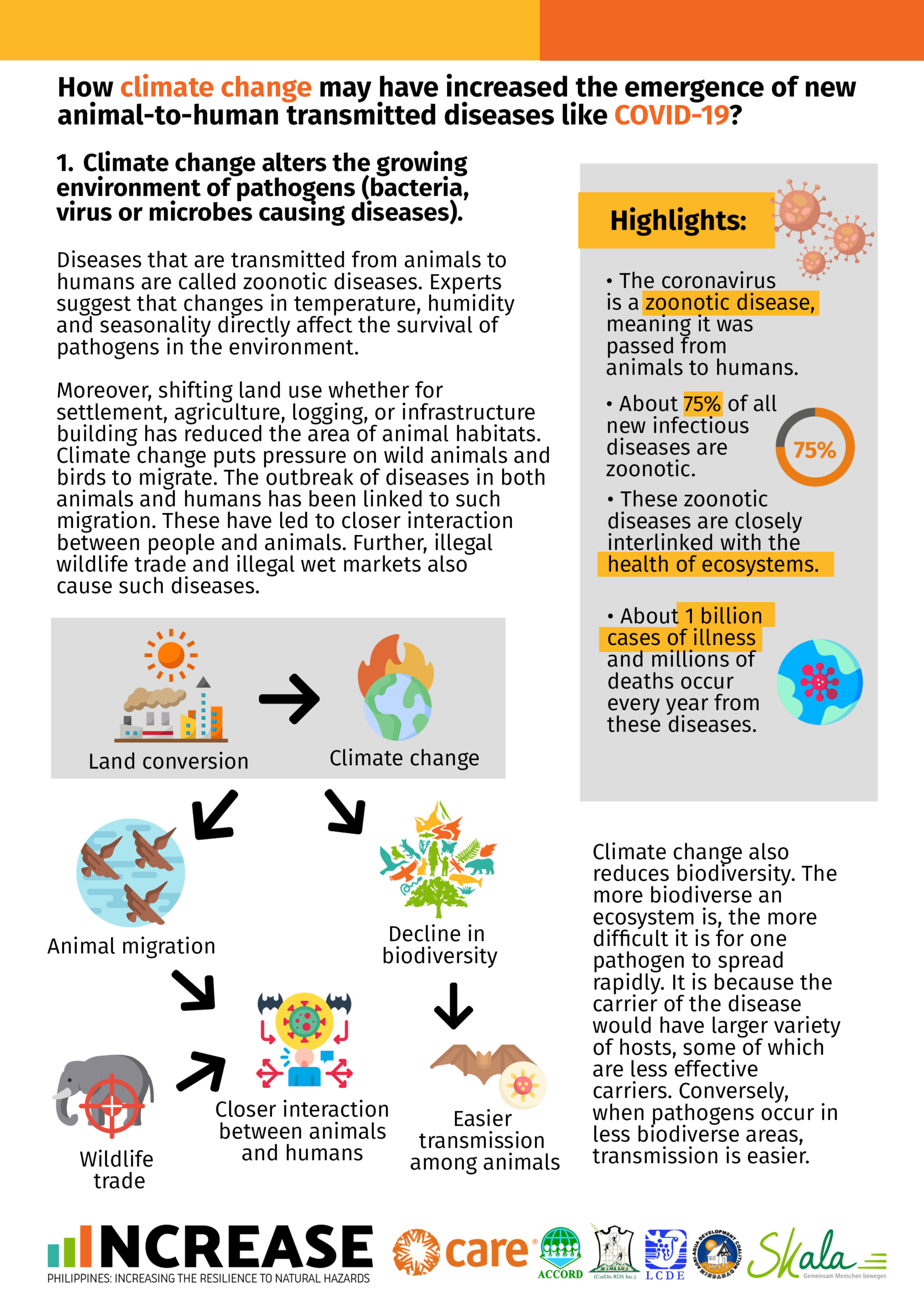
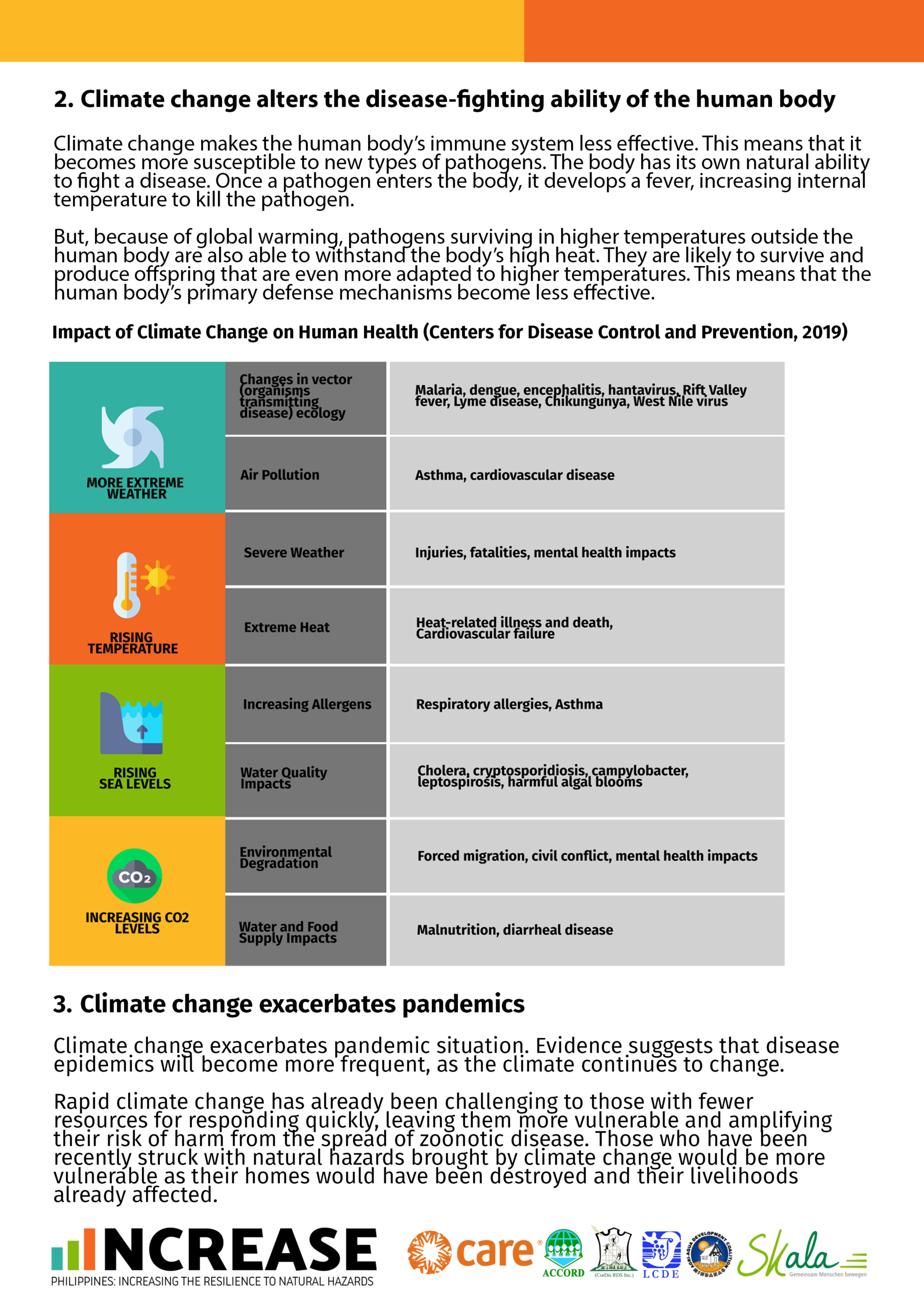
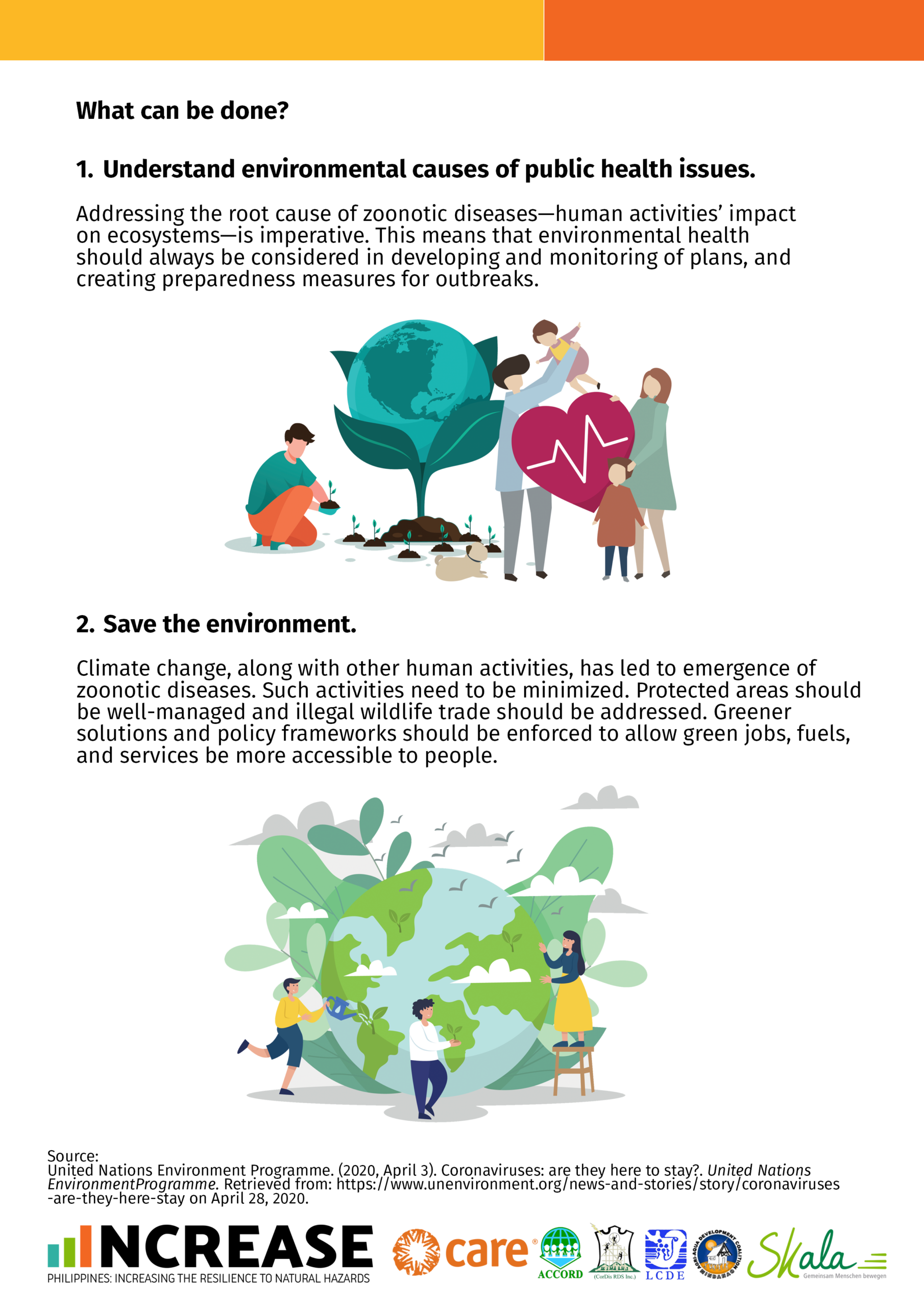
This summarizes the United Nations Environment Programme report on coronaviruses and explains the correlation between climate change and diseases. It also includes an infographic of the impact of climate change to human health and steps that people can collectively act on.
Click on the photos in the gallery below to enlarge and download a soft copy of these materails.
To address the confusion among Filipinos about the difference between the 2 available tests for COVID-19, this infographic (in Filipino language) was created. If you think you have coronavirus disease 2019 (COVID-19) and need a test, contact your health care provider, local pharmacy, or local health department immediately.
You may save the image below for a soft copy of this material.

INCREASE or “Philippines – Increasing Resilience to Natural Hazards” aims to aims to increase the resilience of 45,00 women and men small scale farmers and fishers, including 720 extremely poor female-headed households, to natural hazards and the effect of climate change. The project will run from 2019-2021 in different parts of the Philippines, namely 36 barangays across 8 municipalities in the provinces of Cagayan, Mt. Province, Northern Samar, and Surigao del Sur. Its project components and activities include early warning systems, alternative livelihood, and climate and disaster governance.
 The global pandemic known as the coronavirus disease 2019 (COVID-19) has affected millions worldwide. Presently in the Philippines, the number of cases continues to increase with 9.90% positivity rate and 1.85% mortality rate. The most vulnerable population is comprised of the elderly, those with comorbidities such as diabetes, hypertension, or those who are immunocompromised such as people living with HIV, as well as frontline workers in health and essential businesses.
Health system capacity has improved but continues to face challenges. The country currently ranks 20th in the John Hopkins case monitoring dashboard in terms of the country with the highest number of COVID-19 cases. The number of new cases remains variable with a recent spike following a 2-week decline. The Department of Health (DOH), however asserts that the health system has made significant progress not only in improving recovery rates and reducing COVID-19 mortality, but also in increasing hospitals’ capacity to serve suspected/ confirmed COVID-19 patients.
Currently, there is some 42.1% occupancy rate in wards, ICU, and isolation bedsfor COVID-19. Critical health facilities are now more equipped to provide better care to patients compared to during the early stages of the pandemic. However, testing and contact tracing capacity needs to be sustained to accurately
reflect the health situation. On September 2, the national government launched its official contact tracing app – staysafe.ph, while Local Government Units (LGU) also initiated individual contact tracing strategies/app in their respective communities.
The Philippine government utilized a public health-centered approach in mitigating the spread of the virus. Medical response includes strengthening health capacity by recruiting additional 20,000 health professionals, improved and expanded research capacity, and improved health care facilities and care protocols. Community quarantines include imposition of curfew, ban on mass gatherings, closures of schools or congregations, work suspension, and modified work arrangements.
 COVID-19 has resulted in severe socio-economic consequences. The response to the pandemic transmission has negatively impacted the economy. Since March 2020, more than 3.3 million workers have lost their jobs. Unemployment rate is at 10% as of July 2020 which is double the rate of 5.4% last year of the same month. The loss of livelihood and lack of income opportunities has limited the access of the poorest families to food, water, and health services, and increased their reliance on aid. Some 7.6M reported involuntary hunger due to the crisis.10 School suspension displaced learners, barred access to supplementary feeding, and increased care work for women. Moreover, the affected population articulated increased feelings of anxiety and distress due to the continuing uncertainty of the situation. The pandemic situation shows disproportionate impact of the pandemic to women, children, and the most marginalized sectors of society.
The Philippines remains at risk to disasters and climate change impacts. The country ranks 3rd in the World Risk Report of 2018 and 5th in the Climate Risk Index of 2019.12 Tropical cyclones account for the largest disaster-related loss in the country. Some 20 tropical cyclones occur in the Philippine Area of Responsibility (PAR) per year. At least 6-9 incidents make landfall causing damage to urban and rural communities. Due to climate change, recent historical data in the country show that stronger typhoons are becoming even more frequent. Degraded ecosystems also exacerbate the impacts of the hazard. Moreover, cyclones are often accompanied by concurrent hazards including floods, flashfloods, and landslides. It also interacts with seasonal and climatological changes including monsoon seasons and El Nino Southern Oscillation (ENSO) phases. The typhoon season has already started. Typhoon Vongfong made landfall in May 2020. It was the first typhoon to hit the country this year. It affected almost 400,000 individuals and destroyed shelter, livelihoods, and health facilities. Emergency response activities were complicated by the ongoing quarantine measures and social distancing protocols. The experience from Typhoon Vongfong showed the need to integrate minimum health standards to better prepare for similar hazard events.
On 14 June 2020, the Philippine Atmospheric Geophysical and Astronomical Services Administration (PAGASA) announced the start of the rainy season. The climate outlook shows that that there is more than 50-55% chance of La Nina either late October or November 2020 which may last through the first quarter of 2020. Above normal rainfall incidents can also be expected in the same period, particularly in December. Moreover, a total of 9 to 12 tropical cyclones are expected to enter the Philippine Area of Responsibility (PAR) until the end of the year. The onset of La Nina will cause tropical cyclones to form nearer land, thereby increasing the chance of landfall.
Capacities are stretched, and resources are dwindling. The whole country was placed under State of Calamity since 16 March 2020-12 September 2021.17 The protracted response due to COVID-19 has depleted resources of the government, private sector, and Civil Society Organizations. LGUs affected by the pandemic have already exhausted their Local Disaster Risk Reduction and Management Fund- Emergency Response Fund (LDRRMF-ERF) and have realigned their development funds to provide food assistance, conduct awareness-raising activities, and supplement health equipment and services. Medical and government front liners have provided continuous health and social services.
With the advent of the Typhoon season alongside the continuous COVID-19 response, there is a need to revisit plans to better manage risks and increase response capacities. Contingency plans (CP) can be reviewed to update risk assessments, integrate Infection Prevention and Control (IPC) protocols, and improve response arrangements. Other government plans including the DRRM Plans, Annual Investment Plans (AIP), and Comprehensive Development Plans (CDP) may also benefit from the review process.
The Contingency Planning Checklist is an attempt to summarize experiences from the ground into a diagnostic tool that supports the integration of COVID-19 protocols and lessons from the ongoing response into existing Contingency Plans. It is a list of recommendations across multiple sectors that can serve as an entry point in the CP updating process.
Read, view, and download the complete document here.
Originally Written: April 2, 2013
Jalila Anugod, at 19 years old is a widow with a 6-month old baby girl. Her husband died months ago. Jalila lives with her in-laws who helped her support her baby. She was all smiles as she crossed the bridge holding her baby that day.
Asked why she looked so happy, she timidly answered that the bridge was wonderful (maayo). Few men were working on the bridge that day since it rained hard. The water level of Kapay River has risen and the current has gotten stronger, so the people were allowed to use the bridge while some workers continue to fix the cyclone wire railings. 
Asked how the bridge is useful to her, without hesitation she says that she is able to save on the fare that she pays for the use of the raft. From barangay Dulag where she resides and going to Iligan, Jalila has to shell out about P500 for the fare. This is too much for her who just relies mainly on the support of her parents-in-law to survive.
“I need to go to Iligan for the immunization and regular check-up of my baby girl. There is only one midwife who covers barangay Dulag and two other barangays. Most of the time there is no supply of basic medicines so they have to provide for our own,” confides Jalila. “I also fear riding the raft, and I especially fear for my baby. Riding a raft while carrying your baby is very difficult because you have to balance everything. Much more if the current is strong. Many times, the raft got detached to the rope where it is tied. Because of this and the prohibitive transportation expenses, I often get discouraged to go to the town center. But I also realize the importance of my baby’s immunization and regular check-ups.”
“In the end, this will also benefit me and my baby.“
With the construction of the bridge, there is no more fear in crossing the river, there is no more hesitation to get that important immunization and regular check-up, and the transportation costs will hopefully be reduced significantly. Says Jalila: “I no longer fear that my baby will fall into the river. My baby will get her immunization and regular check-ups, especially since transportation costs will no longer be as expensive.”
“The burden of supporting me and my baby that is borne by my parents-in-law would hopefully be reduced, not only in terms of supporting my baby’s needs. The cost of transporting my father-in-law’s agriculture produce would be reduced, thereby affording him more income. In the end, this will also benefit me and my baby,” Jalila says in closing.
The footbridge was constructed through the Washi emergency response project funded by the European Commission Humanitarian Aid department.
View and download a PDF version of this article here.
Originally Written: January 15, 2013
Indigenous peoples living in upland, and difficult-to-reach communities in Boston and Cateel municipalities in Davao Oriental are facing long-term food shortage and hunger if they are not able to plant fast-maturing crops by February at the latest.
At present, CARE and other organizations, such as the Department of Social Welfare and Development in partnership with the World Food Program, are meeting immediate food needs through food distribution. There is uncertainty, however, as to how long this food distribution will last. In a best-case scenario, these communities will have access to food supplies up to mid-March only. 
The source of livelihood of these indigenous communities, like most of the population Davao Oriental, is growing coconut, oil palm, rubber and falcata trees in smallholder plots, or by working in plantations. All these were destroyed by typhoon Pablo, resulting in the long-term loss of livelihoods. Coconut, oil palm, rubber and falcata trees take time, no less than three years, before becoming productive again.
Indigenous peoples also plant upland rice (traditional rice variety); and vegetables such as eggplants, string beans, okra and pechay; and root crops such sweet potato and cassava. These are grown mainly for household consumption. These crops were also destroyed by typhoon Pablo.
Residents of remote and hard-to-reach barangays Aliwagwag, Malibago and Maglahus in Cateel municipality, and Simulao, Caatihan and Cawayanan in Boston municipality, mostly indigenous peoples, are subsisting on food rations. In the face of uncertainty over the long term, they are asking for support so that they are able to acquire seeds so that they can immediately start their livelihood recovery, and avert long-term food shortage.
According to the local seasonal calendar for agriculture, February is the season for planting vegetables, upland rice, and other crops. If this planting season is missed, the next planting season will be during the third quarter of the year yet. Missing the February 2013 planting season would have serious implications on the well-being of the indigenous communities in Boston and Cateel.
Support to the livelihood recovery activities of the 9,940 indigenous peoples residing in Aliwagwag, Malibago and Maglahus in Cateel municipality, and Simulao, Caatihan and Cawayanan in Boston municipality will avert long-term food shortage and hunger among these vulnerable populations. Their timely livelihood recovery can be supported by providing them seeds, including seeds of fast-maturing crops (less than three months) such as radish, mustard green, okra and eggplant in order to augment their food sources in the earliest possible time.
View and download a PDF version of this article here.
These guidelines come from the Department of Health which is intended for all Filipinos, whether owning a business, running a school, or driving a public utility vehicle, or an individual going to these places, to reduce our risk of exposure to the virus that causes COVID-19. It is in Filipino language and comes with visual aids, so they can be easily digested by readers.
View and download a copy of the posters through this link.
INCREASE or “Philippines – Increasing Resilience to Natural Hazards” aims to aims to increase the resilience of 45,00 women and men small scale farmers and fishers, including 720 extremely poor female-headed households, to natural hazards and the effect of climate change. The project will run from 2019-2021 in different parts of the Philippines, namely 36 barangays across 8 municipalities in the provinces of Cagayan, Mt. Province, Northern Samar, and Surigao del Sur. Its project components and activities include early warning systems, alternative livelihood, and climate and disaster governance.
Based on the released public health standards of the Department of Health, this infographic aims to remind INCREASE communities of the simple steps they can do at home to prevent getting sick.
You may save the image below to have a copy of this material.

INCREASE or “Philippines – Increasing Resilience to Natural Hazards” aims to aims to increase the resilience of 45,00 women and men small scale farmers and fishers, including 720 extremely poor female-headed households, to natural hazards and the effect of climate change. The project will run from 2019-2021 in different parts of the Philippines, namely 36 barangays across 8 municipalities in the provinces of Cagayan, Mt. Province, Northern Samar, and Surigao del Sur. Its project components and activities include early warning systems, alternative livelihood, and climate and disaster governance.