The Moving Urban Poor Communities in Mindanao towards Resilience Project (MOVE UP-Mindanao) is an urban resilience project aimed at contributing to the resilience building of urban poor populations to withstand and manage the impact of disasters. It seeks to strengthen the urban disaster preparedness, response, and management capacity of the national, sub-national, and local government units (LGUs) and other stakeholders through the adaption and replication of tested urban resilience strategies.
In partnership with the Department of the Interior and Local Government-Local Government Academy (DILG-LGA), the project intends to share its lessons learned, good practices, and innovations gathered and tested from its experience working with urban poor communities, municipalities, and provinces to contribute to the large-scale resilience-building effort.
MOVE UP Mindanao is implemented by a consortium of international non-government organizations which includes Plan International Philippines, Action Against Hunger, and CARE Philippines with its local partner ACCORD Inc. Funded by the European Civil Protection and Humanitarian Aid Operations (ECHO), the project is currently being implemented in nine (9) local government units (LGUs) in Mindanao.
The Resilience Knowledge Exchange Series (RKES) Session covering this topic was held on May 27, 2021 which aimed to :
Share the experience of CARE and ACCORD regarding their IRM mainstreaming work;
Provide guidance on how to implement mainstreaming using the recently-published Mainstreaming Integrated Risk Management: An Accompanying Guide to Planning; and
Serve as an introductory session and a preparation for more detailed, comprehensive IRM mainstreaming sessions in the future.
Invited offices from the Malabon LGU (City Planning and Development Department, Disaster Risk Reduction and Management Office, and City Environmental and Natural Resources Office) presented their institutional mandates and their engagement with CARE’s and ACCORD’s projects in the past. They also described their practice in mainstreaming DRR and CCA in their local plans before working with CARE and ACCORD. Furthermore, these offices shared Integrated Risk Management (IRM) value in their local plans and planning processes.
These presentations on Mainstreaming Integrated Risk Management in the Local Government Units’ Planning System in the context of Malabon City were created and presented by Ms. Ma. Lina Punzalan, Mr. Roderick Tongol, Ms. Elizabeth Gutierrez, and Ms. Mariedel Barbin, respectively.
To access a soft copy of the CPDO presentation, please click here.
To access a soft copy of the DRRMO presentation, please click here.
To access a soft copy of the CENRO presentation, please click here.
To access a soft copy of the presentation from Brgy. Potrero, please click here.
The Moving Urban Poor Communities in Mindanao towards Resilience Project (MOVE UP-Mindanao) is an urban resilience project aimed at contributing to the resilience building of urban poor populations to withstand and manage the impact of disasters. It seeks to strengthen the urban disaster preparedness, response, and management capacity of the national, sub-national, and local government units (LGUs) and other stakeholders through the adaption and replication of tested urban resilience strategies.
In partnership with the Department of the Interior and Local Government-Local Government Academy (DILG-LGA), the project intends to share its lessons learned, good practices, and innovations gathered and tested from its experience working with urban poor communities, municipalities, and provinces to contribute to the large-scale resilience-building effort.
MOVE UP Mindanao is implemented by a consortium of international non-government organizations which includes Plan International Philippines, Action Against Hunger, and CARE Philippines with its local partner ACCORD Inc. Funded by the European Civil Protection and Humanitarian Aid Operations (ECHO), the project is currently being implemented in nine (9) local government units (LGUs) in Mindanao.
The Resilience Knowledge Exchange Series (RKES) Session covering this topic was held on May 27, 2021 which aimed to :
Share the experience of CARE and ACCORD regarding their IRM mainstreaming work;
Provide guidance on how to implement mainstreaming using the recently-published Mainstreaming Integrated Risk Management: An Accompanying Guide to Planning; and
Serve as an introductory session and a preparation for more detailed, comprehensive IRM mainstreaming sessions in the future.
This presentation on Mainstreaming Integrated Risk Management in the Local Government Units’ Planning System was created and presented by Ms. Ma. Stella Dulce, IRM Specialist.
To access a soft copy of this material, please click here.
Looking for a presentation from the same event and can’t find it?
Kindly note that if there are unavailable presentations at the moment, they are still being finalized and will be uploaded as soon as available to the RILHUB team.
This report was written by Andrew Hattle with contributions by Christopher Roy and Hans Peter Dejgaard of INKA Consult and by John Nordbo and
Bart Weijs of CARE.
The study was commissioned by CARE Denmark and CARE Netherlands, under the guidance of John Nordbo, Bart Weijs, Obed Koringo and Camilla
Schramek. Sven Harmeling and Inge Vianen provided input.
The views expressed in this publication are those of the authors and do not necessarily represent those of CARE International.
The research and analysis used to produce this report are based on six national reports published by civil-society organisations partnered with
CARE in Ethiopia, Ghana, Nepal, the Philippines, Vietnam and Uganda. Sincere thanks to the following researchers and contributors: Sileshi Zewdie
(CARE), Neima Aliyi (CARE), Yonas Gebru (CCC-E), Yoseph Arega (CCC-E), Meskir Tesfaye (CCC-E), Alazar Daka (CCC-E), Abdul-Razak Saeed (Destreza
Consult), Elvis Oppong-Mensah (Civic Response), Jonathan Gokah (KASA Ghana), Vincent Awotwe-Pratt (Biodiversity Advocates), Chibeze Ezekiel
(Strategic Youth Network for Development), Godlove Otoo (Institute of Green Growth Solutions), Fati Seidu Tambro (SUNG Foundation), Albert
Katako (Civic Response), Raju Pandit Chhetri (Prakriti Resources Centre), Sneha Rai (Prakriti Resources Centre), Binay Dhital (Prakriti Resources
Centre), Athena Denise Gepte (ACCORD), Kairos de la Cruz (ICSC), Aarjan Dixit (CARE), Elainne Lopez, Danica Supnet (ICSC), Janssen Martinez (ICSC),
Isabella Mendoza (ICSC), Angelika David (ICSC), Nguyen Thi Yen (CARE), Vu Minh Hai (CARE), Vu Cong Lan (SRD), Nguyen Thi Tho (SRD), Thuan
Sarzynski (SRD), Robert Bakiika (EMLI), Christine Mbatuusa (EMLI), Jaliah Namubiru (EMLI), Zerubabeeli Naturinda (Consultant), Joshua Zake
(Environmental Alert), Gaster Kiyingi (Tree Talk Plus), Margaret Barihaihi (Consultant), Monica Anguparu (CARE), Annet Kandole (CARE), Robert
Otim (CARE), Emmanuel Musa Kyeyune (EMLI).
The briefer aims at familiarizing INCREASE target communities with the definition and characteristics of Integrated Risk Management (IRM). It also contains the CARE IRM Framework and the elements in increasing resilience. The content was written in local language for easier understanding of community members. This will be printed in a flyer and distributed as supplementary information material for INCREASE activities.
Click on images in the gallery below to enlarge and download this resource.
INCREASE or “Philippines – Increasing Resilience to Natural Hazards” aims to increase the resilience of 45,00 women and men small scale farmers and fishers, including 720 extremely poor female-headed households, to natural hazards and the effect of climate change. The project will run from 2019-2021 in different parts of the Philippines, namely 36 barangays across 8 municipalities in the provinces of Cagayan, Mt. Province, Northern Samar, and Surigao del Sur. Its project components and activities include early warning systems, alternative livelihood, and climate and disaster governance.
Among the key activities of INCREASE Project is the farmer field business school (FFBS). To aid local partners in implementing the FFBS, this briefer was created to summarize the definition, characteristics, elements, and step-by-step process of FFBS. It is hoped that through this briefer, the women and men farmers will know the basics of FFBS and will be able to also use it to further inform other farmers in their community..
Click on images in the gallery below to enlarge and download this resource.
INCREASE or “Philippines – Increasing Resilience to Natural Hazards” aims to increase the resilience of 45,00 women and men small scale farmers and fishers, including 720 extremely poor female-headed households, to natural hazards and the effect of climate change. The project will run from 2019-2021 in different parts of the Philippines, namely 36 barangays across 8 municipalities in the provinces of Cagayan, Mt. Province, Northern Samar, and Surigao del Sur. Its project components and activities include early warning systems, alternative livelihood, and climate and disaster governance.
by INCREASE
Cagayan Province, where two INCREASE municipalities (Amulung and Cagayan) are located, have been heavily devastated by a series of typhoons—Category 3 Typhoon Molave, Category 5 Super Typhoon Goni, and Category 4 Typhoon Vamco in a span of three weeks. This has brought the worst flooding the province has recorded for the last 40 years. The lost lives, livelihood, and shelter exacerbated the already difficult situations of the communities whose mobility and sources of income have been limited because of the pandemic.
Before the disaster
Before the onslaught of the disasters, INCREASE field team has been deployed to conduct community risk assessments and community-based disaster risk reduction and management trainings in Amulung and Gattaran. In such activities, farmers and fishers, along with women, the elderly, youth, persons with disabilities, and other vulnerable persons provided valuable insights on sector-specific hazards, risks, and vulnerabilities in their communities. The barangay captain from Brgy. Annabuculan, Amulung, Cagayan expressed his newfound appreciation for how preparedness measures should be conducted. He appreciated the Community Risk Assessment conducted by INCREASE in their barangay, saying “the information [we] learned were useful and helped us realize the importance of assessments and conducting early action in order to mitigate the disaster.” This has proven how important such activities in building the capacities of the communities in responding to disasters. In addition, information materials such as primers on hazards and evacuation measures were also distributed to community members to help them prepare for the typhoons. The team also coordinated with the barangay DRRM council and monitored and disseminated information from PAGASA so it can be shared with community members.
INCREASE areas in Amulung and Gattaran were severely affected by Typhoon Vamco.
The team has also proceeded with household selection for resilient livelihood activities. During which, they have identified the evolving needs of the community. Because of the pandemic, community members are restricted to travel and need to secure food sources within their area. Together with the local government, the team will help them establish communal gardens which can help sustain the food needs of the community while also diversifying their source of income. Organic farming orientations promoting sustainable farming techniques were also implemented in the area. As farmers and community members are used to synthetic farming, the orientations helped them gain knowledge on natural farming practices that do not cause harm to the ecosystem.
Emergency Response
During the flooding disaster, the team has also been present on the ground. It helped in the facilitation of resource mobilization for emergency response and aid delivery, through conducting assessments in INCREASE areas and participating in the joint Rapid Damage Assessment and Needs Analysis (RDANA). Its visibility increased the local government’s trust and support for the project.
Facilitating resource mobilization for emergency response has helped in building stronger relationship with LGUs
The team has also seen this as an opportunity to lobby for the mainstreaming of integrated risk management in local development plans, since the disaster was caused by the inter-linkages of disasters, climate change impacts, and ecosystem degradation. It has also initiated landscape-wide early warning systems to be established.
INCREASE or Increasing the Resilience to Natural Hazards aims to increase the resilience of 45,000 women and men small-scale farmers and fishers, including 720 extreme poor female-headed households, to natural hazards and the effects of climate change. The project is supported by the SKala initiative. SKala is driven by the German entrepreneur Susanne Klatten in partnership with the think tank and non-profit consultancy PHINEO.
Despite the wealth of data about disasters in Metro Manila, no dedicated study has holistically examined the risks associated with the Malabon-Navotas-Tullahan-Tinajeros river system (MANATUTI), especially in an urban landscape perspective. A pilot risk assessment of the river system was conducted using the integrated risk management, landscape, and urban resilience 190 approaches. Document analyses, key informant interviews, focus group discussions, and field visits were done to identify and analyze the hazards that pose threats to the communities along MANATUTI, especially the urban poor, and how vulnerabilities aggravate and capacities mitigate these risks, especially in the socio-economic, environmental, infrastructural, institutional, and governance aspects of the river system. Communities in the river system face severe risk to compound hazards such as flooding exacerbated by ground subsidence, sea-level rise, and storm surge, fire and liquefaction resulting from earthquake, and public health outbreaks made favorable by increasing temperature, environmental pollution, and congestion, among others. These are worsened by extreme poverty and the powerlessness of the greater population and the highly fragmented urban planning and risk management efforts in the landscape. Nevertheless, the inclination of the communities toward collaboration and transformation, alongside expansive rooms for improved governance, are important capacities that may enhance their resilience to disaster. A formal, well-supported, landscape-wide, inter-community governing institution that practices equitable distribution of responsibilities and resources is deemed essential to realize a comprehensive and effective disaster risk reduction and management in the river system in the face of rapidly changing climate and environment.
To view and download the full document, please click here.
The climate outlook for February-April 2021 was based on PAGASA Climate Forum. This contains the compiled relevant climate information for INCREASE areas and are sent to each specific municipality. This can be used as a guide to planning out activities including food production so climate-related risks are reduced. This is updated every quarter.
Below you may find a gallery of photos detailing the climate outlook for the said period. There are also area-specific versions of the material. You may click on each photo to enlarge it or access the download link.
The 2020 Alternative Temporary Shelter (ATS) Manual is an initiative of the Moving Urban Poor Communities in the Philippines toward Resilience (MOVE UP) Project. This manual is intended for new and experienced users with zero to advanced ATS System and shelter response knowledge. This manual aims to describe the importance and practical applications of ATS and offer step-by-step guidance on properly adopting and implementing select ATS solutions as a form of shelter response and early action during emergencies. This manual provides guidance to local government units, civil society organizations, community members, and other stakeholders on addressing the immediate shelter needs of internally displaced populations (IDPs) within a 24- hour to 36-hour period after a disaster and even for long-term displacements while conforming with universally accepted humanitarian principles and standards. This manual is a working document and shall be updated from time to time.
Target Users
This manual is principally intended for local government units (LGUs) and communities to augment their shelter response and early action capacities during emergencies. The manual also targets the private sector, civil society organizations (CSOs), humanitarian organizations, and other actors working closely with communities to build their resilience.
This report is based on CARE and ACCORD’s partnership with communities, PAGASA, and PHIVOLCS in previous projects implemented using Integrated Risk Management, and which received support funding from the European Civil Protection & Humanitarian Aid Operations (ECHO) and the Partners for Resilience project.
Natural hazards, climate change, and unrestrained ecosystem degradation are spawning extreme events, resulting in massive losses of lives and livelihoods.
Early warning systems (EWS) are crucial in reducing the risks to which vulnerable communities are exposed: effective ones can save countless lives and livelihoods, and less effective ones can turn hazards into disasters and extreme events.
It can provide the opportunity for individuals, communities, governments, businesses, and others to take timely action to reduce risks in advance of hazardous events. This, in turn, contributes to building community resilience. But for an EWS to be effective, it needs to be end-to-end, people-centered or community-based, and landscape-wide.
Community-based refers to an EWS that gives premium to community participation and ownership of the system. A landscape approach means it encompasses larger landscapes such as river basins or watersheds. This requires the harmonization of systems within a landscape, and cooperation among political and administrative units sharing the same landscape.
In the municipality of Saint Bernard in the province of Southern Leyte, the setting up of the EWS, among other DRR and climate change adaptation actions, was occasioned by a landslide that wiped out an entire barangay (village) in 2006. The event underscored the municipality’s vulnerability to multiple hazards and the urgent need to improve preparedness.
Through the collaboration of the municipal LGU, government agencies, civil society organizations, and community members, the EWS was instituted. In 2013, their community-based local flood EWS was recognized by the UN Sasakawa Award for Disaster Reduction for its innovative approach that combines technology and comprehensive social preparation. It was one of six projects from around the world that received the award.
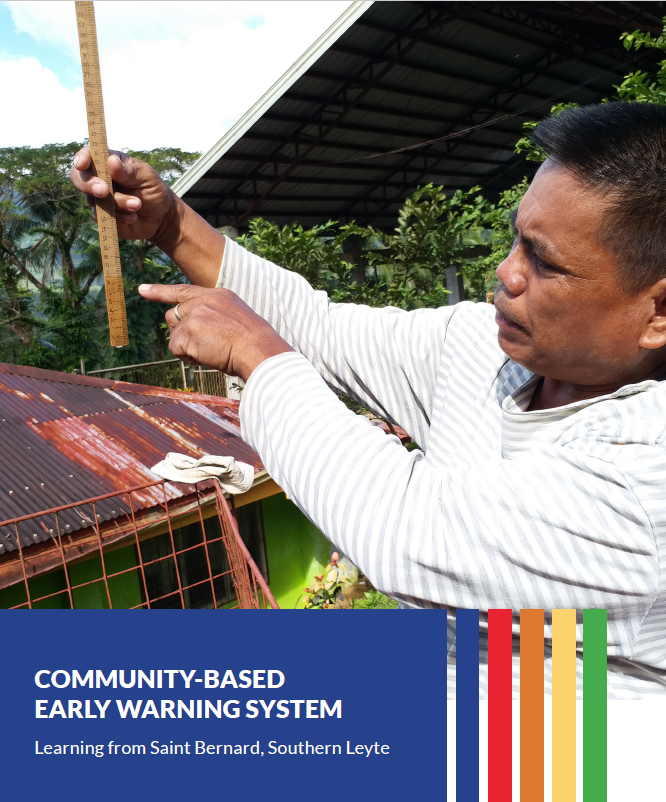
This study presents Saint Bernard’s experiences and lessons learned in setting up and managing the end-to-end, community-based, and landscape-wide EWS for floods, landslides, and tsunamis.
To provide the best experiences, we use technologies like cookies to store and/or access device information. Consenting to these technologies will allow us to process data such as browsing behavior or unique IDs on this site. Not consenting or withdrawing consent, may adversely affect certain features and functions.
Functional
Always active
The technical storage or access is strictly necessary for the legitimate purpose of enabling the use of a specific service explicitly requested by the subscriber or user, or for the sole purpose of carrying out the transmission of a communication over an electronic communications network.
Preferences
The technical storage or access is necessary for the legitimate purpose of storing preferences that are not requested by the subscriber or user.
Statistics
The technical storage or access that is used exclusively for statistical purposes.The technical storage or access that is used exclusively for anonymous statistical purposes. Without a subpoena, voluntary compliance on the part of your Internet Service Provider, or additional records from a third party, information stored or retrieved for this purpose alone cannot usually be used to identify you.
Marketing
The technical storage or access is required to create user profiles to send advertising, or to track the user on a website or across several websites for similar marketing purposes.