Similar to how spectacles may help one see a picture clearer and in more detail, using a gender lens in our planning and programming to ensure that we are able to consider all perspectives in a situation. A gender lens allows us to permeate the systems in which we operate so that gender is never forgotten.
As we continue to feel our way through living amidst the pandemic that has set us back decades economically, not to mention having pushed the medical and technological fields to new limits, we need to take a moment to view our next steps and actions in a way that considers the gender-specific risks and experiences that should inform and shape all of our interventions. Arguably the most pressing issue of our generation, climate change does not wait, slow down, or stop for anyone, especially for us humans who have been the greatest exploiters of our environment and natural resources.
The 15th International Conference in Community-based Adaptation to Climate Change, or simply CBA15, brings together practitioners, grassroots representatives, local and national government planners, policymakers, and donors working at all levels and scales to discuss how we can drive ambition for a climate-resilient future.
It aims to provide an innovative, interactive space for the global CBA community of practice to come together to promote effective, locally-led climate action. The conference videos and presentations shared by both experts and community members also provide a valuable learning resource for practitioners and policymakers during and after the event to continue the conversation on adaptation and climate change.
Held from June 14-18, 2021, CBA15 includes 2 “cross-cutting” themes – Gender and Monitoring, Evaluation and Learning (MEL). These themes were introduced to draw attention to two essential topics – equally relevant across organizations and disciplines within adaptation – that have not typically been given enough attention in previous conferences.
Gender here focuses on the differences in the way climate change affects men and women, and the power structures and socially constructed norms that affect the way men and women are able to shape, access, or derive benefits from adaptation solutions. It is more than simply focussing on women’s perceived climate vulnerabilities and participation in CBA. Gender may also incorporate discussions of “intersectionality”, the way in which the social identities of different people intersect to create a particular type of experience of marginalization or vulnerability to risks. Discussions on gender should recognize the way in which gender identities maintain the drivers of vulnerability and the importance to change power relations and norms to ensure climate resilience for all.
MEL focuses on the need to track the outcomes of projects, learn from successes and failures, and incorporate that learning into the way the adaptation community carries out its work. MEL has been typically undervalued and underfunded among the adaptation community, and taking MEL seriously requires practitioners to think carefully about how they prioritise the implementation of projects and programmes. Any thematic discussion could engage with the particular challenges raised by ensuring that outcomes and recommendations are monitored and assessed appropriately.
By creating “cross-cutting” themes, the objective is for gender and MEL to be integrated across the different sessions at CBA, including thematic workshops, peer-to-peer training and the marketplace. We also aim to demonstrate that these issues are applicable across themes – there are no topics or areas of discussion where they are not relevant, or their consideration does not raise new challenges.
Albeit completely virtual due to pandemic restrictions around the world, RILHUB was able to participate as a gender champion in the following sessions:
Voices from the Frontline: Resilience Lessons from Communities
This session brought together community voices from the “Voices from the Frontline” initiatives, discussing local responses to COVID-19 and how local action can be supported.
The Voices from the Frontline has been supporting communities across the globe in sharing their stories on the challenges of and the responses to the COVID-19 pandemic. The initiative has shed light on the different ways that local communities are self-organizing and effectively mobilizing sources of resilience in the face of the pandemic and the consequent lockdown.
The session was lead by the Global Resilience Partnership, the International Centre for Climate Change and Development, and the Climate and Development Knowledge Network. It applied a talk show format to bring together community voices from the initiative, academics, local government representatives, and international organizations in an engaging and deep conversation.
Pathways to Youth Inclusion in the Local Governance of Climate Action
Youth inclusion in the adaptation processes is pertinent at the local government level where they could make invaluable contributions through their energy, vision, and ideas to help shape climate change adaptation measures and policies.
The session sought to explore Pathways to Youth Inclusion, answering these questions:
What are the key areas for youth inclusion in adaptation processes at the local governance level?
What barriers and enabling factors exist for meaningful youth inclusion?
How do we ensure gender favourable youth inclusion in local climate action?
Generally, the session will explore various views on youth and gender inclusion in local adaptation processes. It was lead by the Green Africa Youth Organization and the Official Youth Constituency of the UNFCCC.
What Women Want: How Grassroots and Urban Poor Women are Impacting Change in Climate Adaptation Policy and Practice
This session highlighted how grassroots needs are being articulated, and open discussions around financing solutions for the urban poor.
SDI and Huairou Commission showcased how grassroots and urban poor women are effectively innovating, engaging, and advocating for changes in policy and practice that speak to their priorities and needs. It shared the methods they are using, and how this work pushes forward adaptation efforts that are truly community-based in order to effect change from the local to global levels.
This session was facilitated by Slum Dwellers International and the Huairou Commission.
Zoom is Marvellous
Ideal for trainers, youth workers, managers, community builders, and generally anyone who needs inspiration for Zoom, this session tackled safety considerations and how to be inclusive and engaging in online spaces. It shared methods of how to move beyond ‘presentation’ style sessions to creative interactive sessions by sharing different experiences, fears, and joys of working online.
This session was facilitated by Rehearse the Revolution.
Climate Storytelling for Impact
The need to challenge ourselves to move past the mono culture of past climate narratives by identifying and amplifying the biodiversity of stories and communication as diverse as the ecosystem we seek to save was highlighted in this session.
Formatted as a peer-to-peer learning session, it shared a case study on impactful storytelling through film, what storytellers are doing to catalyze climate communication and a breakout group exercise on how to strategize with a story for impact.
This session was lead by DOCUBOX, Docsociety, and the Indian Documentary Foundation.
By providing avenues for discussion, learning, and knowledge exchange, there are more spaces for marginalized and vulnerable groups like women, children, and indigenous peoples to voice out their specific experiences, concerns, and proposed solutions that are from the perspective of those on the ground. It was highlighted how specific sessions throughout the week-long event were dedicated to amplifying the voices of women and girls in the frontlines and other sessions were either very gender-sensitive, gender-balanced in terms of speakers and facilitators, or at the very least, conscious of not being gender harmful in any way. As representatives of the CBA community of practice shared their reflections on the conference and what needs to happen next alongside high-level panelists during the closing plenary of the event, it was notable to see varied and colorful observations related to or suggestions on how to “use the momentum of the super-year to transform adaptation and address structural inequalities”.
RILHUB continues to strive to create and support various opportunities for learning, reflection, and the sharing of best practices among partners, communities, and stakeholders.
The Moving Urban Poor Communities in Mindanao towards Resilience Project (MOVE UP Mindanao) is an urban resilience project which aims to contribute to the resilience building of urban poor populations to withstand and manage the impact of disasters. It aims to strengthen urban disaster preparedness, response, and management capacity of the national, sub-national, and local government units (LGUs), and other stakeholders through the adaption and/or replication of tested urban resilience strategies.
MOVE UP- Mindanao project advocates, among others, the strengthening of shock responsive social protection mechanisms to help reduce vulnerability and support timely recovery in the event of shocks and stresses.
In partnership with the Department of Interior and Local Government – Local Government Academy, the project aims to share its lessons learned, good practices, and innovations gathered and tested from its experience in working with urban poor communities to contribute to the large-scale resilience-building effort.
MOVE UP- Mindanao is implemented by a consortium of international non-government organizations which includes Plan International Philippines, Action Against Hunger, and CARE Philippines with its local partner ACCORD Inc. Funded by the European Civil Protection and Humanitarian Aid Operations (ECHO), the project is currently implementing in 9 LGUs in Mindanao.
BACKGROUND OF THE SESSION
Effective social protection is critical to reduce vulnerability and support timely recovery. However, to date, national systems have been too underdeveloped or not flexible enough to allow them to expand before or during emergencies.
This webinar will discuss the basic concepts of shock-responsive social protection and the MOVE UP projects strategies in its goal to help LGUs strengthen their social protection mechanisms to respond to and recover from shocks and stresses.
This webinar will also share some good practices at the local level in implementing anticipatory action strategies in the context of disaster risk reduction and management.
This session was aimed at the following objectives:
1. Provide an overview on the basic concepts of shock-responsive social protection; and
2. Share good practices in implementing Disaster Risk Reduction and Management strategies in the context of social protection from local experiences.
These presentations used during this learning session are as follows:
The Urban Resilience Model and Basic Concepts of Shock-Responsive Social Protection
by Mr. Roger Cabiles, Head of Project and Consortium Manager, MOVE UP-Mindanao Project, Action Against Hunger Philippines
This presentation describes the MOVE UP project’s Urban Resiliennce Model, its tried and tested model for disaster resilience developed through years of working with urban poor communities and local government units. It also explores the basic concepts of shock-responsive social protection, its difference to social protection, basic social services, disaster response, and the legal bases and frameworks which support its implementation. Moreover, the interconnectedness of these two strategies is also explored.To access a copy of this presentation, please click this link.
BREADY Project Presentation by Mayor Melchor Llego Mergal, Municipal Mayor, Salcedo, Eastern SamarThis presentation shares the inspiring and good practice of Salcedo, Eastern Samar in the implementation of its pre-emptive cash transfer program with the help of the BREADY Project by Oxfam and Plan International Philippines. Mayor Melchor Mergal shares the processes they’ve undergone to implement the program, including their realizations and challenges.
To access a copy of this presentation, please click this link.
SRSP Synthesis
by Mr. Arnel Sanchez, Social Protection Specialist, MOVE UP – Mindanao Project, Plan International PhilippinesThis presentation summarizes the points raised during the webinar and highlighted certain challenges in the implementation of shock-responsive social protection projects in the Philippines.To access a copy of this presentation, please click this link.
The briefer aims at familiarizing INCREASE target communities with the definition and characteristics of Integrated Risk Management (IRM). It also contains the CARE IRM Framework and the elements in increasing resilience. The content was written in local language for easier understanding of community members. This will be printed in a flyer and distributed as supplementary information material for INCREASE activities.
Click on images in the gallery below to enlarge and download this resource.
INCREASE or “Philippines – Increasing Resilience to Natural Hazards” aims to increase the resilience of 45,00 women and men small scale farmers and fishers, including 720 extremely poor female-headed households, to natural hazards and the effect of climate change. The project will run from 2019-2021 in different parts of the Philippines, namely 36 barangays across 8 municipalities in the provinces of Cagayan, Mt. Province, Northern Samar, and Surigao del Sur. Its project components and activities include early warning systems, alternative livelihood, and climate and disaster governance.
The climate outlook for February-April 2021 was based on PAGASA Climate Forum. This contains the compiled relevant climate information for INCREASE areas and are sent to each specific municipality. This can be used as a guide to planning out activities including food production so climate-related risks are reduced. This is updated every quarter.
Below you may find a gallery of photos detailing the climate outlook for the said period. There are also area-specific versions of the material. You may click on each photo to enlarge it or access the download link.
by Tanya Mariano, ACCORD, Inc
This report is based on CARE and ACCORD’s partnership with communities, PAGASA, and PHIVOLCS in previous projects implemented using Integrated Risk Management, and which received support funding from the European Civil Protection & Humanitarian Aid Operations (ECHO) and the Partners for Resilience project.
Natural hazards, climate change, and unrestrained ecosystem degradation are spawning extreme events, resulting in massive losses of lives and livelihoods.
Early warning systems (EWS) are crucial in reducing the risks to which vulnerable communities are exposed: effective ones can save countless lives and livelihoods, and less effective ones can turn hazards into disasters and extreme events.
It can provide the opportunity for individuals, communities, governments, businesses, and others to take timely action to reduce risks in advance of hazardous events. This, in turn, contributes to building community resilience. But for an EWS to be effective, it needs to be end-to-end, people-centered or community-based, and landscape-wide.
Community-based refers to an EWS that gives premium to community participation and ownership of the system. A landscape approach means it encompasses larger landscapes such as river basins or watersheds. This requires the harmonization of systems within a landscape, and cooperation among political and administrative units sharing the same landscape.
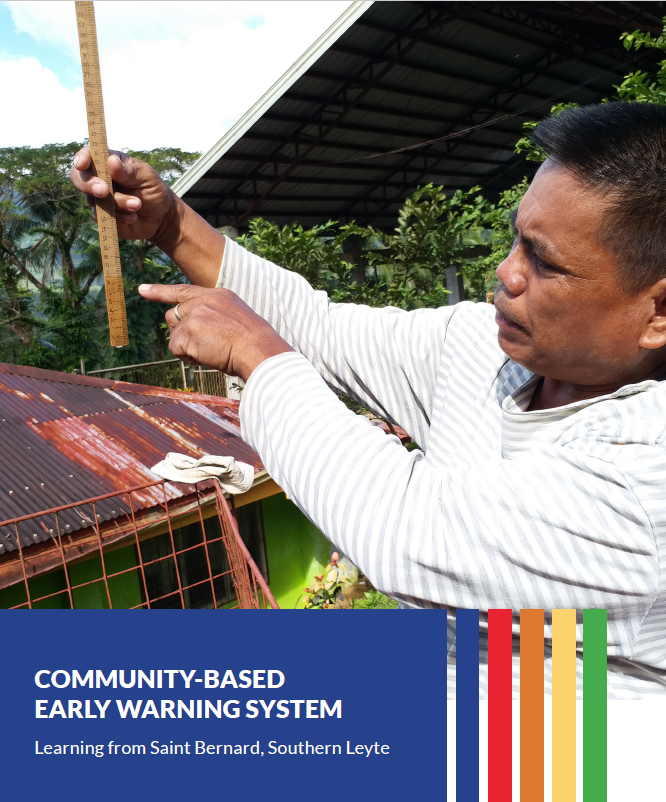
In the municipality of Saint Bernard in the province of Southern Leyte, the setting up of the EWS, among other DRR and climate change adaptation actions, was occasioned by a landslide that wiped out an entire barangay (village) in 2006. The event underscored the municipality’s vulnerability to multiple hazards and the urgent need to improve preparedness.
Through the collaboration of the municipal LGU, government agencies, civil society organizations, and community members, the EWS was instituted. In 2013, their community-based local flood EWS was recognized by the UN Sasakawa Award for Disaster Reduction for its innovative approach that combines technology and comprehensive social preparation. It was one of six projects from around the world that received the award.
This study presents Saint Bernard’s experiences and lessons learned in setting up and managing the end-to-end, community-based, and landscape-wide EWS for floods, landslides, and tsunamis.
As the Philippines enters La Nina season, public advisories help in preparing communities. Specific agri-weather advisories were presented in these infographics for each INCREASE area.
Please refer to the advisories per area below:
INCREASE or “Philippines – Increasing Resilience to Natural Hazards” aims to increase the resilience of 45,00 women and men small scale farmers and fishers, including 720 extremely poor female-headed households, to natural hazards and the effect of climate change. The project will run from 2019-2021 in different parts of the Philippines, namely 36 barangays across 8 municipalities in the provinces of Cagayan, Mt. Province, Northern Samar, and Surigao del Sur. Its project components and activities include early warning systems, alternative livelihood, and climate and disaster governance.
October 1, 2012
By Pia Lee-Brago (The Philippine Star)
This report was first published in print in issue on The Philippine Star on 30 September 2012.
Saint Bernard, Southern Leyte, Philippines – The Philippines is ahead of its Southeast Asian neighbors in disaster preparedness, according to European Union.
Ambassador Guy Ledoux, of the Delegation of the European Union to the Philippines, witnessed the country’s progress in disaster risk reduction program here and has commended the collaborative efforts of the local government units, non-government organizations and communities to help save lives and lessen damage in times of disaster.
“There is now global recognition and importance of disaster risk reduction.”
Ledoux cited the country’s disaster risk reduction and climate change adaptation practices.
The National Conference for Effective Disaster Risk Reduction and Climate Change Adaptation Practices was held here Friday with Ledoux as guest speaker.
According to the United Nations Office for Disaster Risk Reduction (UNISDR), Asia remains the worst affected continent and nine out of 10 countries with the highest number of disaster-related deaths were in Asia.
“It has been demonstrated in many cases that a highly effective way of reducing the need for humanitarian aid is to invest in disaster risk reduction measures, including ensuring greater preparedness of people at risk. There is now global recognition and importance of disaster risk reduction,” Ledoux said in his speech.
The conference gathered more than 100 disaster risk reduction practitioners from high-risk communities from Regions II, V, XII, CAR and Caraga targeted by the EU disaster preparedness program.
(Photo credit to Gregorio Dantes Jr.)
To access a soft copy of this story, please click here.
Integrated Risk Management Training Manual (4 modules) Contents:
Module 4: Mainstreaming DRR, CCA, at EMR sa mga planong pangkaunlaran
This manual is written for facilitators who will conduct training in communities that are vulnerable to various hazards.
It may also be useful for members of disaster risk reduction and management bodies in schools and at the community, barangay, city, and municipal levels; and other non-government organizations.
It is written in Filipino and presents the technical subject matter in terms that are easily understandable, and in a format that is easily readable. Among other resources, it contains tools to conduct community risk assessments.
This Manual was originally published in Filipino in 2009, bearing the title Pagsasanay sa Disaster Preparedness at Contingency Planning. The publication in Filipino was intentional. The targeted users of the manual were high-risk communities and local authorities in the Philippines. Moreover, the choice made by CARE and the Corporate Network for Disaster Response to propagate the community-based approach to disaster risk reduction dictated that the manual be published in Filipino.
Much has transpired since the manual’s publication in 2009. The manual was a product of the Strengthening Assets and Capacities of Communities and Local Governments for Resilience to Disasters (ACCORD) project. Two follow-up community-based disaster risk reduction projects have since been completed, also supported by the European Commission Humanitarian Aid and Civil Protection department (ECHO). A five-year community-based disaster risk reduction programme was also started in 2011, with funding from the Ministry of Foreign Affairs of The Netherlands. These projects have served to enrich the content of the training manual.
Aside from the foregoing explicit DRR projects, other projects implemented by CARE and partners CNDR, Cordillera Disaster Response and Development Services (CorDisRDS), Agri-Aqua Development Coalition (AADC) and Assistance and Cooperation for Community Resilience and Development (ACCORD Inc.) have used Pagsasanay sa Disaster Preparedness at Contingency Planning. Five emergency response projects since Ketsana (Ondoy) and a food security and livelihood project funded by the EuropeAid have used the manual as a means for mainstreaming DRR in emergency response. This experience likewise contributed to the enrichment of Pagsasanay.
Over three years of practical experience later, frameworks, approaches and concepts have clarified and evolved. Tools and learning methodologies have vastly improved. These developments required that Pagsasanay be updated. An updated Pagsasanay would feature the addition of sessions on climate change adaptation and ecosystem management and restoration. This is in recognition of present realities – that disasters are becoming more frequent and more destructive because of climate change and environmental degradation. These aspects were not present in the original manual. Other additions are the sessions on relevant DRR and CCA laws and the organization of functional Disaster Risk Reduction and Management Councils (DRRMCs). There were two push factors for these inclusions. One is the passage of the Philippine Disaster Risk Reduction and Management Act and the Climate Change Act.
The second factor is closely linked to the first: village, municipal and school authorities wanted to know more about the new laws and are requesting assistance for them to be able to comply with the provisions of the laws. So then why an English edition? Early on, there was already a demand for an English edition from those who do not read and speak Filipino. The lack of an English edition prevented the dissemination of the manual on a wider scale, within the Philippines and beyond.
Training on Disaster Preparedness and Contingency Planning is the response to the oft-received request for an English translation of the manual. Updating of the original manual in Filipino, and its translation and publication in English are a fulfilment of the obligation of CARE and partners to share what has been developed from experience and collaboration amongst high-risk communities and local authorities.
This Manual was originally published in Filipino in 2009, bearing the title Pagsasanay sa Disaster Preparedness at Contingency Planning. The publication in Filipino was intentional. The targeted users of the manual were high-risk communities and local authorities in the Philippines. Moreover, the choice made by CARE and the Corporate Network for Disaster Response to propagate the community-based approach to disaster risk reduction dictated that the manual be published in Filipino.
Much has transpired since the manual’s publication in 2009. The manual was a product of the Strengthening Assets and Capacities of Communities and Local Governments for Resilience to Disasters (ACCORD) project. Two follow-up community-based disaster risk reduction projects have since been completed, also supported by the European Commission Humanitarian Aid and Civil Protection department (ECHO). A five-year community-based disaster risk reduction programme was also started in 2011, with funding from the Ministry of Foreign Affairs of The Netherlands. These projects have served to enrich the content of the training manual.
Aside from the foregoing explicit DRR projects, other projects implemented by CARE and partners CNDR, Cordillera Disaster Response and Development Services (CorDisRDS), Agri-Aqua Development Coalition (AADC) and Assistance and Cooperation for Community Resilience and Development (ACCORD Inc.) have used Pagsasanay sa Disaster Preparedness at Contingency Planning. Five emergency response projects since Ketsana (Ondoy) and a food security and livelihood project funded by the EuropeAid have used the manual as a means for mainstreaming DRR in emergency response. This experience likewise contributed to the enrichment of Pagsasanay.
Over three years of practical experience later, frameworks, approaches and concepts have clarified and evolved. Tools and learning methodologies have vastly improved. These developments required that Pagsasanay be updated. An updated Pagsasanay would feature the addition of sessions on climate change adaptation and ecosystem management and restoration. This is in recognition of present realities – that disasters are becoming more frequent and more destructive because of climate change and environmental degradation. These aspects were not present in the original manual. Other additions are the sessions on relevant DRR and CCA laws and the organization of functional Disaster Risk Reduction and Management Councils (DRRMCs). There were two push factors for these inclusions. One is the passage of the Philippine Disaster Risk Reduction and Management Act and the Climate Change Act.
The second factor is closely linked to the first: village, municipal and school authorities wanted to know more about the new laws and are requesting assistance for them to be able to comply with the provisions of the laws. So then why an English edition? Early on, there was already a demand for an English edition from those who do not read and speak Filipino. The lack of an English edition prevented the dissemination of the manual on a wider scale, within the Philippines and beyond.
Training on Disaster Preparedness and Contingency Planning is the response to the oft-received request for an English translation of the manual. Updating of the original manual in Filipino, and its translation and publication in English are a fulfilment of the obligation of CARE and partners to share what has been developed from experience and collaboration amongst high-risk communities and local authorities.
To provide the best experiences, we use technologies like cookies to store and/or access device information. Consenting to these technologies will allow us to process data such as browsing behavior or unique IDs on this site. Not consenting or withdrawing consent, may adversely affect certain features and functions.
Functional
Always active
The technical storage or access is strictly necessary for the legitimate purpose of enabling the use of a specific service explicitly requested by the subscriber or user, or for the sole purpose of carrying out the transmission of a communication over an electronic communications network.
Preferences
The technical storage or access is necessary for the legitimate purpose of storing preferences that are not requested by the subscriber or user.
Statistics
The technical storage or access that is used exclusively for statistical purposes.The technical storage or access that is used exclusively for anonymous statistical purposes. Without a subpoena, voluntary compliance on the part of your Internet Service Provider, or additional records from a third party, information stored or retrieved for this purpose alone cannot usually be used to identify you.
Marketing
The technical storage or access is required to create user profiles to send advertising, or to track the user on a website or across several websites for similar marketing purposes.
 The 15th International Conference in Community-based Adaptation to Climate Change, or simply CBA15, brings together practitioners, grassroots representatives, local and national government planners, policymakers, and donors working at all levels and scales to discuss how we can drive ambition for a climate-resilient future.